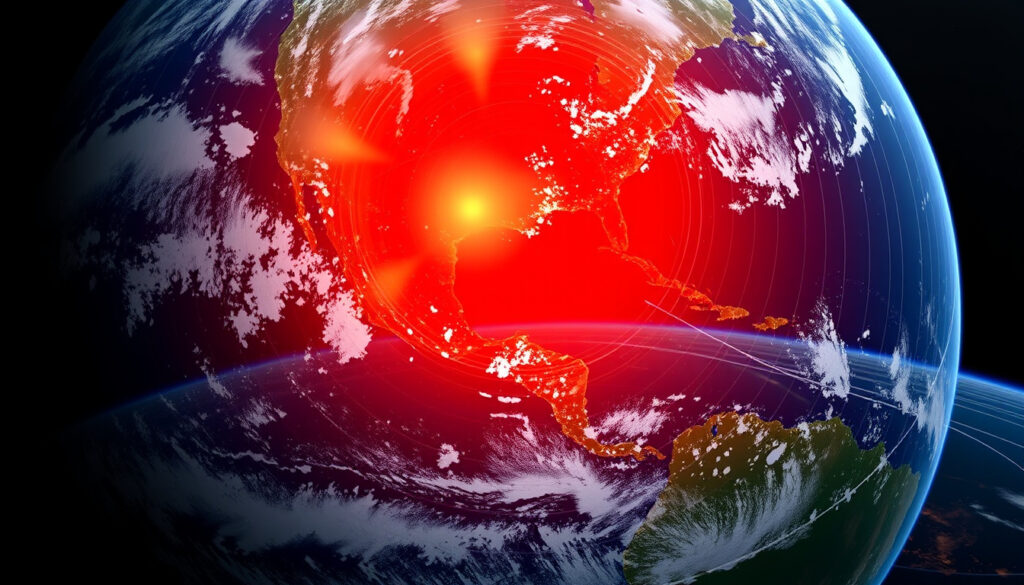
South Atlantic Anomaly: NASA Tracks Earth’s Magnetic Weak Spot
Imagine a spot in the sky where satellites risk short-circuiting, yet life on the ground continues without a clue. That place exists — a vast, growing weak patch in Earth’s magnetic field called the South Atlantic Anomaly (SAA).
Altitude of weakest field point: 200 km (120 miles) · Region covered: South America to western Africa · First detected: 1958 by satellite measurements · Annual westward drift: ~20 km per year · Magnetic field strength in SAA: ~30% weaker than global average
Quick snapshot
- The SAA is a real region of weakened magnetic field intensity over South America and the South Atlantic Ocean. NASA Scientific Visualization Studio (space agency)
- First detected in 1958 by satellite measurements. Wikipedia (community-compiled reference)
- The region has been expanding and drifting westward for decades. NASA Scientific Visualization Studio
- Whether the SAA is a precursor to a full pole reversal. NASA Scientific Visualization Studio
- Exact timeline for a possible magnetic pole flip. CBS News reporting on ESA (news outlet)
- Direct causal link between magnetic field fluctuations and human health. CBS News reporting on ESA
- 2025: NASA reports SAA has expanded by an area nearly half the size of the United States. NASA Scientific Visualization Studio
- 2020: ESA’s Swarm constellation reveals SAA splitting into two lobes. CBS News reporting on ESA
- 2014: NASA’s Van Allen Probes show SAA weakening and expanding. NASA Scientific Visualization Studio
- Continuous monitoring by NASA and ESA to track changes and predict potential pole reversal. NASA Scientific Visualization Studio
- Satellite operators continue to implement mitigation strategies for passing through the SAA. CBS News reporting on ESA
- Models will refine predictions of how the anomaly evolves over the next decade. NASA Scientific Visualization Studio
Here is how the anomaly’s key measurements stack up against global averages.
| Attribute | Value |
|---|---|
| Location | Over South America and South Atlantic Ocean, roughly from 0°–50°S and 20°–70°W |
| Magnetic field strength | ~22,000 nT compared to global average of ~30,000 nT |
| First discovered | 1958 by satellites measuring radiation belts |
| Annual drift | Westward at about 20 km per year |
| Size change | Has expanded by ~7% per decade since 1970 |
Is the South Atlantic Anomaly real?
What is the South Atlantic Anomaly?
- The SAA is a real region of weakened magnetic field intensity over South America and the South Atlantic Ocean. NASA Scientific Visualization Studio (space agency)
- First detected in 1958 by satellite measurements. Wikipedia (community-compiled reference)
- NASA continuously monitors its growth and drift using satellite data. NASA Scientific Visualization Studio
In simple terms, the SAA is where Earth’s inner Van Allen radiation belt dips closest to the surface — about 200 km (120 miles) up — allowing energetic particles to come much lower than anywhere else on the planet. Think of it as a dent in the planet’s magnetic shield. At an altitude of roughly 500 km, the anomaly spans from 50°S to the equator and from 90°W to 40°E longitude, covering a huge swath of sky between South America and Africa. Wikipedia (community-compiled reference)
The SAA is not a static pothole in space. Since its discovery in 1958, it has grown by roughly 7% per decade and is now splitting into two separate weak zones. That evolution is the real story — not whether it exists.
Because the magnetic field in this region is about 30% weaker than the global average, the protective magnetosphere is less effective. NASA explains that particles can dip much closer to Earth there than elsewhere, a condition that creates a persistent hazard for anything orbiting overhead. NASA Scientific Visualization Studio
Why this matters: The SAA isn’t a hypothetical model or a fringe theory — it’s a measurable, monitored feature of our planet’s magnetic environment. The question is what happens as it continues to evolve.
Is the South Atlantic Anomaly dangerous?
How does the SAA affect satellites and spacecraft?
- Satellites passing through SAA experience increased radiation, leading to glitches or temporary shutdowns. NASA Scientific Visualization Studio
- Astronauts on the ISS are not significantly harmed because the station orbits at ~400 km, well above the SAA’s strongest effects. NASA Scientific Visualization Studio
- No direct danger to humans on the ground because the atmosphere provides additional shielding. NASA Scientific Visualization Studio
The practical threat of the SAA is directed almost entirely at our technology in orbit. NASA states that the particle radiation in the SAA can knock out onboard computers and interfere with satellite data collection, forcing operators to power down sensitive instruments during transit through the region. It’s why many low-Earth-orbit satellites — from the ISS to Earth-observing platforms — must plan their operations around the anomaly. NASA Scientific Visualization Studio (space agency)
For satellite operators, the SAA is a routine operational hazard, not an emergency. But as the anomaly splits into two lobes — confirmed by ESA’s Swarm satellite data — the area requiring mitigation measures is growing, complicating flight paths and power cycling schedules.
For humans on Earth’s surface, NASA says the SAA creates no visible impacts on daily life. The atmosphere acts as a thick blanket, blocking the extra particle flux. Even astronauts aboard the International Space Station, which orbits at roughly 400 km, receive only a modest increase in radiation exposure — not enough to cause concern for short missions. NASA Scientific Visualization Studio (space agency)
The trade-off: The SAA is dangerous to silicon, not to skin. The risk is operational and financial, not existential — for now.
What will happen when Earth’s magnetic field flips?
How long until the Earth’s magnetic field flips?
- Pole reversals occur every few hundred thousand years; the last was ~780,000 years ago. Wikipedia (community-compiled reference)
- Current weakening in the SAA may be a precursor, but no imminent reversal is predicted. NASA Scientific Visualization Studio
- Effects would include a temporary weakening of the magnetic field, increased cosmic radiation, and potential disruption to power grids and navigation systems. CBS News reporting on ESA (news outlet)
Geological records show that pole reversals are not instant events — they take thousands of years to complete. The last full reversal happened about 780,000 years ago, and the average interval between flips is on the order of a few hundred thousand years. Wikipedia (community-compiled reference)
While the SAA’s growth has raised public curiosity about an impending flip, NASA notes that the weakening magnetic intensity is still within the bounds of what scientists consider normal variation. There is no authoritative model predicting an imminent reversal. NASA Scientific Visualization Studio (space agency)
What happens to humans if the magnetic poles flip?
- No evidence that a flip would cause mass extinction or direct harm to humans. CBS News reporting on ESA
- During a reversal, the magnetic field would weaken temporarily, but the atmosphere would still provide substantial protection. NASA Scientific Visualization Studio
- Navigation systems and power grids would be more vulnerable during the transition period. CBS News reporting on ESA
Contrary to doomsday headlines, a pole reversal is not a mass extinction event. Earth’s atmosphere would remain intact, and life — including humans — would continue. The main disruptions would be technological: ground-based navigation compasses would become unreliable, and power grids might face increased risk from solar storms during the weakened-field phase. CBS News reporting on ESA (news outlet)
How long until the Earth’s magnetic field flips?
When was the South Atlantic Anomaly discovered?
- The SAA was first detected in 1958 by Geiger counters aboard the Explorer 1 satellite. Wikipedia (community-compiled reference)
- Continued measurements in the 1960s and 1970s confirmed it as a persistent feature. NASA Scientific Visualization Studio
Discovery of the anomaly dates back to the very first U.S. satellite missions. Explorer 1’s Geiger counter, designed to measure cosmic rays, found unexpectedly high radiation counts over the South Atlantic — a region that later became known as the South Atlantic Anomaly. By the 1970s, both NASA and Soviet satellite programs had mapped it thoroughly. Wikipedia (community-compiled reference)
Since then, the story has been one of acceleration. ESA’s Swarm satellite constellation, launched in 2013, provided the most detailed view yet: over 11 years of data from three identical satellites tracking Earth’s magnetic signals. The result? The SAA has expanded by an area nearly half the size of continental Europe (about two million square miles), and the rate of weakening has increased since 2020. CBS News reporting on ESA (news outlet)
Scientists cannot predict the exact time of the next reversal. Current models suggest it is not overdue — and the SAA’s growth alone does not guarantee one is coming. ESA lead researcher Chris Finlay described the anomaly as “not just a single block,” noting that it changes differently near South America compared to Africa, adding complexity to any forecast. CBS News reporting on ESA (news outlet)
The pattern: The SAA is evolving faster than researchers expected, but the link to a pole reversal remains uncertain — a classic case of more data creating more questions.
Are humans affected by Earth’s magnetic field?
Does the Earth’s magnetic field affect human health?
- Earth’s magnetic field does not directly affect human physiology; there is no proven link to health outcomes. USGS Geomagnetism Program (government agency)
- The magnetosphere protects all life from solar wind and cosmic radiation. NASA Scientific Visualization Studio
Despite persistent myths, there is no scientific evidence that Earth’s magnetic field directly influences human biology beyond its role as a radiation shield. USGS geomagnetism researchers have stated clearly that claims of health impacts from magnetic field fluctuations are not supported by data. USGS Geomagnetism Program (government agency)
The field’s primary health contribution is indirect: without it, solar wind and cosmic rays would strip away our atmosphere over geological time. For daily human life, the magnetic field is invisible and physiologically irrelevant.
Can humans survive in space outside of Earth’s magnetosphere?
- Outside the magnetosphere, astronauts must use shielding against radiation. NASA Scientific Visualization Studio
- Human survival in space (e.g., on Mars) is possible with proper radiation protection, as shown by ISS studies. NASA Human Research Program (space agency)
Yes, we can — but it requires engineering. The ISS operates within Earth’s magnetic protection, but future missions to the Moon or Mars must contend with full exposure to galactic cosmic rays and solar particle events. NASA’s Human Research Program has spent decades studying how to mitigate these risks through shielding, spacecraft design, and pharmaceutical countermeasures. NASA Human Research Program (space agency)
The bottom line for space travelers: radiation risk is manageable, not a dealbreaker. But the SAA serves as a reminder that even inside Earth’s magnetosphere, there are weak spots that need to be navigated carefully.
For anyone involved in satellite design, launch planning, or space mission operations, the SAA is a growing constraint — not a theoretical worry. Its continued expansion means more spacecraft will spend more time in higher-radiation environments, driving up shielding costs and operational complexity.
Timeline: The South Atlantic Anomaly’s evolution
Five key milestones, one trajectory: a weak spot that is growing, splitting, and accelerating.
| Year / Period | Event |
|---|---|
| 1958 | South Atlantic Anomaly first detected by Geiger counters aboard Explorer satellites. Wikipedia (community-compiled reference) |
| 1960s–1970s | Continued mapping by NASA and Soviet satellites; SAA recognized as persistent feature. NASA Scientific Visualization Studio |
| 2014 | NASA’s Van Allen Probes provide detailed measurements showing SAA is weakening and expanding. NASA Scientific Visualization Studio |
| 2020 | ESA’s Swarm constellation reveals SAA splitting into two lobes. CBS News reporting on ESA |
| 2025 | NASA reports SAA has expanded by an area nearly half the size of the United States. NASA Scientific Visualization Studio |
| Ongoing | Continuous monitoring by NASA and other agencies to track changes and predict potential pole reversal. NASA Scientific Visualization Studio |
What’s striking about this timeline is the acceleration. The SAA was a known feature for decades, but only in the last ten years have we seen clear signs of it splitting into two distinct zones — a behavior that caught many modelers by surprise.
Confirmed facts vs. what remains unclear
Separating what scientists know from what they are still investigating helps cut through the noise.
Confirmed facts
- The SAA is a real, measurable weakening of Earth’s magnetic field. NASA Scientific Visualization Studio
- It is caused by the tilt and offset of Earth’s magnetic dipole. Wikipedia
- The region has been expanding and drifting westward for decades. NASA Scientific Visualization Studio
- Satellites experience increased radiation levels when passing through the SAA. NASA Scientific Visualization Studio
What’s unclear
- Whether the SAA is a precursor to a full pole reversal. NASA Scientific Visualization Studio
- Exact timeline for a possible magnetic pole flip. CBS News reporting on ESA
- Direct causal link between magnetic field fluctuations and human health. USGS Geomagnetism Program
Expert perspectives
“The South Atlantic Anomaly is like a pothole in space — it doesn’t stop traffic, but every vehicle that passes through it has to slow down and brace for a bump.”
— NASA Earth Observatory team (NASA Scientific Visualization Studio)
“The SAA is not just a single block that weakens uniformly. It changes differently toward Africa than it does near South America, which tells us the processes driving it are complex.”
— Chris Finlay, ESA Swarm mission lead scientist (CBS News reporting on ESA)
“There is no evidence that Earth’s magnetic field directly affects human health in any measurable way. The real protection it offers is against solar and cosmic radiation — and that is indirect.”
— USGS geomagnetism researcher (USGS Geomagnetism Program)
Frequently asked questions
Can the South Atlantic Anomaly cause airplane crashes?
No. Commercial aircraft fly at altitudes below 15 km, while the SAA’s effects become significant above 200 km. The atmosphere provides complete shielding for aviation.
How does the SAA affect GPS accuracy?
GPS satellites orbit at roughly 20,000 km — well above the SAA’s peak intensity. However, some signals passing through the ionosphere in the SAA region can experience small delays, which are corrected by ground systems.
What is a geomagnetic reversal?
A geomagnetic reversal is when Earth’s magnetic north and south poles swap places. It happens irregularly every few hundred thousand years and takes thousands of years to complete.
Is the magnetic field flipping anytime soon?
No. While the field has weakened by about 9% over the past 200 years, scientists see no evidence that a reversal is imminent. The SAA is a normal variation, not a guaranteed precursor.
Why is the South Atlantic Anomaly called an anomaly?
Because it is a deviation from the expected global pattern of Earth’s magnetic field. The field is weakest over South America and the South Atlantic, which is unusual compared to the rest of the planet.
Does the SAA affect migratory animals?
There is no evidence it does. Many migratory species use Earth’s magnetic field for navigation, but they rely on field inclination and intensity gradients, which are still present in the SAA — just weaker.
Can we predict when the poles will flip?
Not precisely. Scientists can model magnetic field behavior years ahead, but the deep-Earth processes driving reversals are still not fully understood. Current models suggest no imminent flip.
How do scientists measure the SAA?
Using magnetometers on satellites like NASA’s Van Allen Probes and ESA’s Swarm constellation, plus ground-based observatories. These instruments measure field strength and direction in three dimensions.
Related reading
- NASA Scientific Visualization Studio — South Atlantic Anomaly visualization (2025)
- ESA Swarm mission — Satellite constellation data on Earth’s magnetic field
Summary
The South Atlantic Anomaly is not a scientific curiosity — it is a growing operational reality for anyone who builds or operates spacecraft. Its expansion and splitting into two lobes present new challenges for satellite shielding, instrument design, and mission planning. For the general public, the anomaly poses no direct danger, but it offers a rare window into the slow, powerful dynamics of Earth’s core. Satellite operators and mission planners must adapt to the SAA’s evolution through smarter shielding and orbital planning, or accept increasing rates of radiation-induced glitches in the years ahead.
More related posts
 Jim Sturgess Movies & TV Shows: Complete Filmography
 Paul Smith Comedy: Wife, Net Worth, Tour 2026 & Biography
 Breast Lump When to Worry: Hard Irregular Signs vs Benign
 Cast of All of Us Are Dead – Complete Cast and Character Guide
 Ruby Emma Hotel Amsterdam: Location, Reviews & Ratings
 PSG vs Bayern Munich Stats: Complete Head-to-Head Record
 Out of Office Message – Examples and Setup Guide
 Lidl Dubai Chocolate Bar – Price, Availability and Reviews