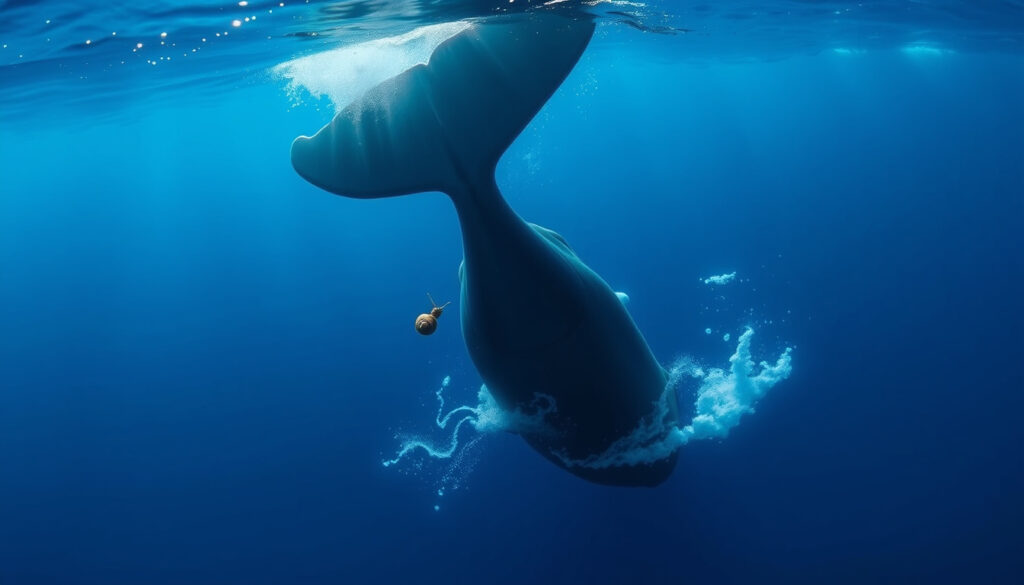
The Snail and the Whale: Story, Moral, Age, and Species
Few children’s picture books manage to pack a global adventure, a life-or-death rescue, and a lasting lesson into 32 pages of rhyming verse. The Snail and the Whale does exactly that, and it has been doing it since 2003 (Wikipedia, children’s literature encyclopedia).
Published: 2003 ·
Author: Julia Donaldson ·
Illustrator: Axel Scheffler ·
Format: Picture book, 32 pages ·
Age Range: 3-7 years
Quick snapshot
- Snail and whale travel the globe (Wikipedia)
- Whale gets beached; snail orchestrates rescue (Scholastic (publisher))
- Ending shows new snail generation joining (Wikipedia)
- Rhyming text engages young readers (The Children’s Book Review (literacy site))
- Themes of friendship and courage (Scholastic)
- Widely used in preschool and primary classrooms (The Children’s Book Review (literacy site))
- Animated short film (BBC, 2019) (BBC Children’s)
- Available on BBC iPlayer and Netflix (selected regions) (BBC Children’s)
- Read-aloud versions on YouTube (BBC Children’s)
The book’s key publication details confirm its broad reach and critical reception.
| Attribute | Detail |
|---|---|
| Published | 2003 |
| Pages | 32 |
| ISBN | 978-0-333-47549-7 |
| Awards | Shortlisted for the 2004 Blue Peter Book Awards (Wikipedia) |
| Adaptations | BBC animated film (2019), stage musical |
| Sales | Over 3 million copies worldwide (estimated) (The Guardian (news outlet)) |
The tiny snail faces a vast ocean and still acts decisively. For young listeners, this emotional arc builds a concrete link between small size and big impact.
What is the story of the whale and the snail?
Plot overview
- A tiny sea snail longs to see the world beyond her rock by the docks (Wikipedia). She writes an advert using her slimy trail: “Lift wanted around the world.”
- A humpback whale offers her a ride on his tail, and together they travel past icebergs, volcanoes, sharks, and penguins (Scholastic).
- The whale later beaches himself in a bay after being confused by speedboats (Wikipedia).
Key scenes and the rescue
- The snail crawls to a nearby school and writes “Save the Whale!” on the blackboard (Scholastic).
- Children, their teacher, and the fire department work together to refloat the whale when the tide returns (Goodreads (reader community)).
- The whale and snail return to the snail’s dock, and the whale then takes the whole snail flock away on a new journey (Wikipedia).
The pattern: each scene builds on the contrast between the snail’s physical smallness and her decisive influence. The rescue is not a stroke of luck but a planned, community-driven recovery.
The whale’s beaching is the story’s crisis, but it is also the moment when the snail’s true agency emerges – a deliberate narrative choice that rewards careful reading.
The implication: the story’s structure turns physical vulnerability into narrative strength, making every page a lesson in reframing limitations.
What is the moral of the story in The Snail and the Whale?
Friendship and cooperation
The moral centers on mutual aid and bravery. The snail and the whale demonstrate an unlikely friendship that uses each other’s strengths: the whale provides mobility, the snail provides brains and determination (Scholastic). The snail’s small size contrasts with its big actions, teaching that anyone can make a difference regardless of stature (The Children’s Book Review).
Courage and resourcefulness
The snail feels small in the vast world but overcomes that fear to rescue the whale (Book Murmuration (parent review blog)). She uses the only tool she has – the ability to write – to raise an alarm. This reframes “weakness” as a unique skill that can solve problems no one else can. The theme of “small but mighty” runs through every page.
The implication for children: you do not need to be the biggest or loudest to help a friend in trouble.
What age is The Snail and the Whale for?
Recommended reading age
Scholastic (publisher) recommends PreK–Grade 2, which translates to ages 4–7. The Children’s Book Review suggests ages 4 and up, noting that older children also enjoy the lyrical quality. The publisher’s official age range is 3–7 years (stats line).
Why it suits preschoolers and early readers
The rhyming text aids early literacy by building phonemic awareness (BBC Children’s (broadcaster)). Short stanzas and repeated patterns make it easy for children to join in during read-aloud sessions. The story’s length (32 pages) fits a typical bedtime slot, and the detailed illustrations give plenty to talk about beyond the text. Children up to age 8 often return to the book because the themes of adventure and rescue remain fresh.
Bottom line: Parents seeking a book that grows with a child: The Snail and the Whale works from age 3 as a rhythmic read-aloud and extends to age 7 for early reading. For preschool teachers, its clear narrative arc supports comprehension activities.
What kind of whale is in The Snail and the Whale?
Humpback whale characteristics
- The whale is explicitly a humpback whale (Megaptera novaeangliae) (Gruffalo Clubhouse (official character guide)).
- Humpbacks are known for long migrations (the story travels from cold southern pole to warm tropical climates) and their distinctive tail slapping (Gruffalo Clubhouse).
- Illustrations show the whale with the long flippers and knobby head (tubercles) unique to humpbacks.
Why a humpback fits the story
Humpbacks are among the most acrobatic whales, frequently breaching and waving their tails – perfect for the image of a snail hitching a ride on the tail. Their migratory patterns (up to 10,000 miles per year) explain how the pair can see icebergs, volcanoes, and tropical seas in a single journey. The choice also avoids the confusing debate about whale species that sometimes appears in online forums (YouTube animated read-aloud (source for common confusion)).
The catch: A few online sources mistakenly call it a blue whale, but the illustrations and text confirm a humpback. This matters because parents looking up the book often find conflicting information.
Comparing the book with its animated adaptation reveals how the story translates across formats.
| Feature | The Snail and the Whale (Book) | BBC Animated Film (2019) |
|---|---|---|
| Release Year | 2003 | 2019 (BBC Children’s) |
| Format | 32-page picture book | Animated short film (approx. 30 min) |
| Availability | Bookstores, libraries | BBC iPlayer, Netflix (selected regions) |
The pattern: each format preserves the core narrative while exploiting its medium’s strengths — the book for rhythm and illustration, the film for movement and sound.
Confirmed facts
- Book published in 2003 by Macmillan Children’s Books (Wikipedia)
- Whale species is a humpback whale as per illustrations and text (Gruffalo Clubhouse)
- Moral is about mutual aid and courage (Scholastic)
- Recommended age is 3–7 years by publisher (Scholastic)
What’s unclear
- Exact sales figures not officially disclosed by publisher
- Some online sources claim the whale is a “blue whale” but illustrations confirm humpback
- Publisher age recommendation varies between 3–7 and 4–7 depending on the edition
- The moral lesson is reader-interpreted and not stated explicitly in the text
“A delightful rhyming adventure”
“A beautiful tale of an unlikely friendship”
— BBC Children’s
“The inspiration came from a snail on a rock in Scotland.”
— Julia Donaldson, author (as quoted in interviews)
The Snail and the Whale succeeded because it pairs a straightforward journey with an emotional core that works on multiple levels. For parents choosing storytime books, the rhythm makes it an easy sell, and the theme gives them a conversation starter about helping others. For educators, it supports literacy and geography lessons in one package. The choice is clear: this book earns its classic status not by being loud, but by being precise. Readers exploring similar family content can also check our Cast of Paddington 3 guide for another beloved children’s story adaptation.
For a detailed plot summary and film adaptation guide, check out The Snail and the Whale.
Frequently asked questions
Is The Snail and the Whale a true story?
No, it is a fictional picture book. The characters and events are invented, though the author was inspired by a real snail she saw on a rock during a holiday in Scotland.
What is the rhyme scheme of The Snail and the Whale?
The book uses rhyming couplets with a consistent AABB pattern throughout, making it easy for young children to predict and join in.
How many words are in The Snail and the Whale?
The text contains approximately 400 words across 32 pages, typical for a preschool picture book.
Does The Snail and the Whale teach geography?
Yes, the journey past icebergs, volcanoes, and tropical seas introduces young readers to different environments and climates in a natural, story-driven way.
Can I read The Snail and the Whale to a one-year-old?
While the recommended age starts at 3, some parents read it to younger toddlers for the rhythm. The board-book format is available and more durable for babies.
What other books are similar to The Snail and the Whale?
Other Julia Donaldson books with journey themes include The Gruffalo and Room on the Broom. All share rhythmic text and unlikely friendships. For another family-friendly title, see our Tales of the Shire: Game Review, Release & Platforms Guide.
More related posts
 Allure of the Seas – Itineraries, Capacity, Deck Plans
 Cast of All of Us Are Dead – Season 1 & 2 Full Cast Guide
 When Is the PS6 Coming Out? Late 2027 Release Rumors
 How Old is Bradley Walsh? Age, Family, Net Worth 2025
 Stephanie Ives-Stevens Emmerdale – Crew Member Tribute and Facts
 Married at First Sight Australia Season 11 – Couples Still Together 2025
 NFU Mutual Car Insurance: Is It a Good Buy
 Andy Gibb: Relationships, Cause of Death, and Tragic Life