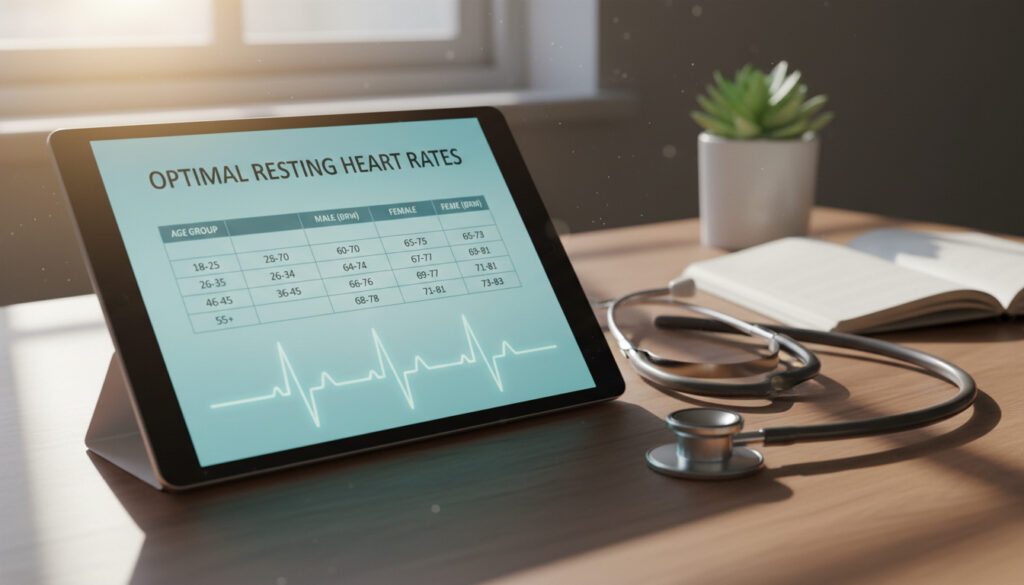
Good Resting Heart Rate – Chart by Age and Gender
A normal resting heart rate for healthy adults falls between 60 and 100 beats per minute, though optimal cardiovascular fitness often correlates with lower values. Medical consensus identifies 55 to 85 bpm as a desirable range for most non-athletic adults, while trained endurance athletes frequently register readings between 40 and 60 bpm without indicating pathology.
Cardiac efficiency varies significantly across populations. Age, biological sex, fitness level, medications, and autonomic nervous system function all modify individual baselines. Regular monitoring establishes personal norms and highlights deviations requiring clinical assessment.
What Is a Good Resting Heart Rate?
60-100 bpm
40-60 bpm
2-7 bpm higher than men
Morning, seated, pre-caffeine
- Fitness correlation: Lower rates generally indicate superior cardiovascular efficiency and stroke volume.
- Athletic exception: Bradycardia below 60 bpm requires clinical context to distinguish fitness from pathology.
- Sex differences: Women maintain consistently higher resting rates than men across all age cohorts.
- Temporal consistency: Morning measurements minimize confounding variables like activity and stimulants.
- Wearable variance: Optical sensors on fitness trackers may deviate 5-10% from manual palpation methods.
- Adaptation timeline: Consistent aerobic training can reduce resting rate by 5-20 bpm within three to six months.
- Upper threshold: Sustained rates exceeding 100 bpm (tachycardia) at rest necessitate medical evaluation.
| Age Group | Good Range (bpm) | Athlete Range | Clinical Notes |
|---|---|---|---|
| Newborns (0-4 weeks) | 100-205 | N/A | Highest baseline due to metabolic demands |
| Infants (1-12 months) | 100-180 | N/A | Gradual deceleration through infancy |
| Toddlers (1-3 years) | 98-140 | N/A | High variability during development |
| School-age (5-12 years) | 75-118 | 60-75 | Approaching adult ranges |
| Teens (13-18 years) | 60-100 | 40-60 | Adult standard ranges apply |
| Adults (18-65 years) | 60-100 | 40-60 | 55-85 bpm optimal for health |
| Seniors (65+ years) | 60-95 | 40-60 | Monitor for arrhythmias and irregularities |
Normal Resting Heart Rate by Age and Gender
Pediatric populations demonstrate significantly higher metabolic rates necessitating elevated cardiac output. Newborns maintain rates between 100 and 205 bpm, gradually decelerating through adolescence until reaching adult parameters around age 18.
Children and Teens
Developmental physiology drives distinct age-specific ranges. Toddlers average 98-140 bpm, while school-age children settle into 75-118 bpm. Teenagers converge on adult standards of 60-100 bpm, though hormonal fluctuations during puberty may introduce temporary variability.
Adults 18-65
Between ages 18 and 65, stable autonomic tone typically produces consistent readings. Men generally exhibit rates 2-7 bpm lower than women due to larger heart mass and testosterone-mediated vagal tone. MedicineNet data indicates that for men aged 18-25, excellent fitness correlates with 56-61 bpm, while women in the same bracket register 61-65 bpm.
Women consistently maintain higher resting heart rates than men across all age categories, averaging differences of 2-7 bpm. This variation reflects disparities in heart size, stroke volume, and hormonal influences on autonomic regulation.
Seniors Over 65
Aging reduces pacemaker cell function and vascular compliance. While 60-95 bpm remains acceptable for adults over 65, Asian Heart Institute guidelines emphasize vigilance regarding irregularities rather than absolute rate, given that fitness preservation can maintain athlete-level bradycardia safely into advanced age.
Is 70 a Good Resting Heart Rate?
Seventy beats per minute sits comfortably within optimal parameters for most adults. For sedentary individuals, 70 bpm indicates adequate cardiovascular health, while trained athletes might view this as elevated, suggesting detraining or incomplete recovery.
Factors Affecting RHR
Multiple variables modulate daily readings. American Heart Association documentation identifies stress, anxiety, dehydration, illness, smoking, and obesity as elevating factors. Conversely, endurance training, adequate sleep, and stress management through meditation lower baseline rates. Medications including beta-blockers and calcium channel antagonists artificially depress measurements.
When to See a Doctor
Symptomatic bradycardia—characterized by dizziness, fatigue, syncope, or chest pain—requires immediate evaluation regardless of absolute rate. Persistent tachycardia above 100 bpm at rest, or new-onset irregularity, similarly demands cardiological assessment. Various symptoms require medical attention, including Bleeding From Anus No Pain – Causes, Risks and When to Worry and cardiac irregularities accompanied by hemodynamic compromise.
Resting Heart Rate Chart by Age
Visual Chart
Detailed age-segmented analysis reveals progressive slowing through middle age followed by plateau. Men aged 26-35 register excellent ranges at 55-61 bpm, while women of identical age demonstrate excellent metrics at 60-64 bpm. By ages 56-65, these ranges converge slightly, with men at 57-61 bpm and women at 60-64 bpm maintaining excellent classifications.
Obtain measurements immediately upon waking while still supine or seated. Avoid caffeine, nicotine, or physical activity for at least 30 minutes prior. Count radial or carotid pulse for 60 seconds rather than 30-second extrapolation to minimize error.
Personalized Assessment
Individual baselines trump population averages. Tracking trends over weeks provides superior insight compared to isolated readings. Cleveland Clinic specialists recommend comparing wearable data against manual palpation monthly, as optical sensors accumulate drift over time.
Rates below 40 bpm frequently indicate underlying conduction system pathology requiring electrophysiological evaluation, except in highly trained endurance athletes with documented fitness adaptations and absent symptoms.
How Long Does It Take to Improve Resting Heart Rate?
- Weeks 1-2: Establish consistent measurement protocols and document baseline without exercise modifications. Mayo Clinic Health System emphasizes standardizing measurement conditions during this phase.
- Weeks 3-4: Initiate moderate aerobic activity (150 minutes weekly) or vigorous activity (75 minutes weekly) per cardiovascular guidelines.
- Month 2: Initial autonomic adaptations manifest as 2-5 bpm reductions. Parasympathetic tone increases with consistent training stimulus.
- Months 3-6: Significant cardiac remodeling occurs. Stroke volume increases, allowing 5-20 bpm reductions in resting rate for previously sedentary individuals.
- Month 6+: Continued refinement through maintenance training. Elite athletes may approach 40 bpm through years of progressive overload.
What Do Cardiologists Know for Certain About Resting Heart Rate?
| Established Evidence | Uncertain or Contextual |
|---|---|
| Normal adult range: 60-100 bpm (AHA consensus) | Optimal rate for longevity (studies vary between 50-70 bpm) |
| Athletes commonly exhibit 40-60 bpm without pathology | Universal applicability of athlete ranges to recreational exercisers |
| Women average 2-7 bpm higher than men | Exact genetic determinants of individual baselines |
| RHR correlates inversely with cardiovascular fitness | Definitive causation versus correlation in mortality studies |
How Does Resting Heart Rate Reflect Overall Health?
Resting heart rate serves as a proxy for autonomic nervous system balance and cardiac efficiency. Lower rates typically indicate robust parasympathetic tone and enhanced stroke volume, reducing lifetime cardiac workload. Harvard Health research associates elevated resting rates with increased cardiovascular mortality independent of other risk factors.
Beyond fitness, RHR signals systemic stress. Infection, inflammation, anemia, and thyroid dysfunction elevate baseline rates before other symptoms manifest. Monitoring provides early warning for subclinical illness and medication side effects, functioning as an accessible biomarker for physiological resilience.
What Do Leading Medical Authorities Say?
A normal resting heart rate for adults ranges from 60 to 100 beats per minute. Generally, a lower heart rate at rest implies more efficient heart function and better cardiovascular fitness.
— American Heart Association
Your resting heart rate can reflect your current and future health. Some studies have found that a higher resting heart rate is associated with an increased risk of cardiovascular disease and mortality.
— Harvard Health Publishing
How Should You Monitor Your Resting Heart Rate?
Establish a consistent daily measurement routine, preferably upon waking, to track personal baselines and identify trends. Combine wearable technology with periodic manual verification, and consult healthcare providers regarding sustained deviations from your established range or the emergence of symptoms like dizziness or palpitations. When preparing to discuss health metrics with clinicians, organizing your observations using structured communication techniques similar to Tell Me About Yourself – Structure, Examples and Tips ensures comprehensive and efficient consultations.
Frequently Asked Questions
How can I lower my resting heart rate naturally?
Engage in 150 minutes of moderate aerobic exercise weekly, maintain healthy body composition, practice stress reduction through meditation or breathing exercises, eliminate tobacco use, and restrict caffeine and alcohol consumption. Consistent application typically produces measurable reductions within three months.
What constitutes a dangerously low resting heart rate?
Bradycardia below 60 bpm requires evaluation when accompanied by dizziness, fatigue, syncope, or chest pain. Rates persistently below 40 bpm warrant medical assessment regardless of symptoms, except in elite endurance athletes with documented fitness adaptations.
Can anxiety or stress permanently elevate resting heart rate?
Acute stress activates sympathetic nervous system responses, temporarily increasing rate. Chronic stress may sustain elevated baselines, though cardiovascular training and stress management techniques can mitigate these effects and restore lower resting rates.
How accurate are smartwatches for measuring resting heart rate?
Optical photoplethysmography sensors in wearables typically vary 5-10% from manual palpation or electrocardiography. Validate device readings against manual counts monthly, and consider medical-grade devices if precise monitoring is clinically necessary.
Why does resting heart rate vary between men and women?
Physiological differences including smaller heart size, reduced stroke volume, and hormonal influences on autonomic function produce consistently higher rates in women, averaging 2-7 bpm above age-matched male counterparts.
Does dehydration affect resting heart rate?
Yes. Reduced plasma volume from dehydration decreases venous return and stroke volume, necessitating increased heart rate to maintain cardiac output. Even mild dehydration (1-2% body mass loss) can elevate resting rate by 3-5 bpm.
More related posts
 Newport Isle of Wight: A Complete Visitor Guide (2025)
 Zach Bryan: Marriages, Sobriety, Rise to Fame Biography
 Where to Watch The Last of Us – UK Streaming Guide for Seasons 1 & 2
 Best Moisturizer for Dry Skin: 9 Dermatologist Picks & 3-Minute Rule
 Emma Grede Net Worth 2025: $405M From Skims & More
 Power Failure London Underground: Cable Fault Chaos
 Plymouth Argyle vs Leeds United Stats – H2H Record & Predictions
 135 Lbs to Kg – Exact Conversion and Practical Guide