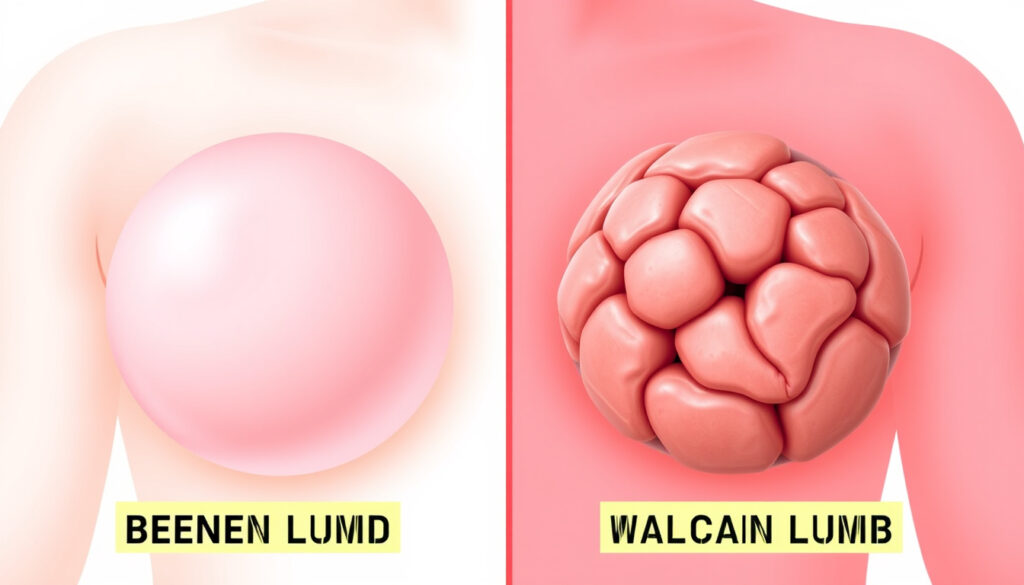
Breast Lump When to Worry: Hard Irregular Signs vs Benign
Finding a lump in your breast can stop you in your tracks. The good news is that most turn out to be harmless — yet waiting to find out is rarely comfortable. Knowing what separates a movable, tender cyst from something that needs urgent attention can save you weeks of unnecessary worry — or get you to proper care faster when it matters. This guide walks you through the signs, textures, and timelines that medical experts from Mayo Clinic and Cleveland Clinic actually use.
90% of breast lumps are benign · All new lumps need GP check · Harder, irregular lumps raise concern · Evaluate regardless of age
Quick snapshot
- 90% of breast lumps are benign (Mayo Clinic Health System)
- Any mass felt for more than 3 days should be checked (Cleveland Clinic)
- Fibroadenomas most common ages 15–35 (Mayo Clinic Health System)
- Exact cancer risk without imaging remains individualized
- Natural remedy efficacy lacks rigorous study data
- Phyllodes tumor behavior varies case by case
- New lump persisting 4–6 weeks needs medical visit (Mayo Clinic)
- Cysts peak in 30s–40s pre-period (Cleveland Clinic)
- Mammograms recommended from age 40 for average risk (Mayo Clinic Health System)
- GP evaluation includes physical exam and imaging
- Ultrasound often first imaging for under-40s
- Biopsy confirms nature if imaging raises concern
Key statistics and clinical thresholds guide the initial assessment of any breast lump you might discover.
| Attribute | Value |
|---|---|
| Most common cause | Cysts or fibroadenomas |
| Urgency rule | See GP immediately |
| Cancer rate | Under 10% |
| Key feel | Hard/irregular concerning |
| Cyst share of lumps | Up to 25% |
| Fibroadenoma age range | 15–35 years |
How do I know if a breast lump is serious?
Not every lump carries the same weight. The texture and behavior of what you feel tell a different story depending on whether it originated as a cyst, a fibroadenoma, or something else entirely. Medical organizations use three primary physical markers to assess seriousness: hardness relative to surrounding tissue, whether the lump is fixed or movable, and whether it comes with skin or nipple changes.
Hard or irregular edges
A lump that feels harder than the surrounding breast tissue — especially if it has irregular, asymmetrical edges rather than smooth borders — warrants professional evaluation. Cleveland Clinic notes that cancerous lumps are often hard, oddly shaped, and feel distinctly different from adjacent tissue.
Fixed to tissue
Benign lumps such as fibroadenomas tend to move freely when you push them. Cancerous masses often become fixed to underlying tissue, meaning they don’t shift when you apply pressure. Cleveland Clinic Health describes that early-stage cancer lumps may be initially movable but can become fixed as they grow.
Associated skin changes
Skin dimpling, puckering, redness, or a texture resembling an orange peel are red flags that go beyond the lump itself. Mayo Clinic emphasizes that any changes in skin color or texture, any new lump or bump that feels different, should be evaluated even if a recent mammogram came back clear.
What are the five warning signs of breast cancer?
Beyond the lump itself, breast cancer announces itself through a constellation of changes that often travel together. Cleveland Clinic and Mayo Clinic have documented the hallmark patterns that prompt specialists to move beyond watchful waiting.
Lump presence
A persistent lump or thickening — often pea-sized or larger — that doesn’t resolve after your menstrual cycle is a primary warning sign. Mayo Clinic specifies that the cancer lump feels different from surrounding tissue and often persists unchanged through hormonal fluctuations.
Skin changes
Redness, scaling, or puckering of the breast skin can signal inflammatory breast cancer or tumor involvement of Cooper’s ligaments. Mayo Clinic adds that skin color changes vary by skin tone — on darker skin, redness may appear as darker or purplish areas rather than the classic flushed red.
Nipple inversion
A nipple that pulls inward or changes direction, spontaneous nipple discharge (especially bloody), or a newly inverted nipple are all flagged by Mayo Clinic Health System as requiring prompt evaluation.
The implication: any combination of these signs — particularly when they persist beyond your next menstrual cycle — warrants same-day contact with your GP rather than waiting for a scheduled check-up.
What kind of breast lumps are normal?
Normal doesn’t mean nonexistent — most breasts have some inherent lumpiness, especially in response to hormonal cycles. Understanding what’s baseline for you helps you notice when something genuinely new appears.
Fibroadenomas
Fibroadenomas are the most common benign tumors in younger women, peaking in the 15–35 age range according to Mayo Clinic Health System. They feel firm, round, smooth, and rubbery — and are usually easily movable under the skin. Cleveland Clinic confirms these are solid, smooth, and mobile.
Cysts
Breast cysts are fluid-filled sacs that can make breast tissue feel lumpy or bumpy. Cleveland Clinic notes that up to 25% of all breast lumps are cysts. They are often tender, especially pre-menstruation, and are most common in women in their 30s and 40s.
What this means: the majority of lumps women find are non-cancerous and related to hormonal fluctuations, yet the same physical characteristics that define “normal” can overlap with early warning signs — which is why clinical evaluation remains essential regardless of how the lump feels.
What does a non-cancer breast lump feel like?
The tactile experience of a benign lump differs from a cancerous one in predictable ways. Mayo Clinic and Cleveland Clinic both emphasize texture, mobility, and pain patterns as the distinguishing factors.
Soft and movable
Benign lumps like fibroadenomas and simple cysts tend to be smooth, well-defined, and mobile — you can often push them slightly to one side. Fibroadenomas feel rubbery and firm but not rock-hard; cysts may feel squishy or fluid-filled.
Tender to touch
Pain and tenderness are more common with benign conditions than with cancer. Cysts often fluctuate in size and tenderness with your menstrual cycle, becoming more noticeable and uncomfortable just before your period.
The catch: pain is reassuring in most cases, but the absence of pain never rules out something serious — early-stage cancers can also be painless, which is why duration and growth matter more than discomfort alone.
What do most cancerous breast lumps feel like?
Cancerous lumps have a distinct physical fingerprint that experienced clinicians learn to recognize. Mayo Clinic describes the feel as hard and different from surrounding tissue — often described as rock-like or irregular rather than smooth.
Hard and irregular
Cleveland Clinic notes that a hard, discrete lump that differs from surrounding tissue is the most common breast cancer sign. These lumps often have irregular borders rather than the smooth, round shape typical of benign fibroadenomas. If you’re concerned about a breast lump, learn more about when to worry by clicking here: біль في البنكرياس.
Fixed in place
Unlike movable benign lumps, cancerous masses tend to become anchored to surrounding tissue. Mayo Clinic confirms that a breast cancer lump feels different from surrounding tissue and often doesn’t shift when you apply pressure. Early-stage cancers may start movable but become fixed as they advance.
The pattern: a lump that combines hardness, irregular borders, and immobility — even without pain — carries the hallmark combination that warrants urgent imaging rather than watchful waiting.
Upsides
- 90% of breast lumps are benign (Mayo Clinic)
- Immediate GP evaluation resolves uncertainty quickly
- Modern imaging catches problems at pea-sized stage (Cleveland Clinic)
- Fibroadenomas and cysts are manageable conditions
Downsides
- Anxiety waiting for imaging results is common
- Some cysts require follow-up monitoring over months
- Skin changes harder to detect on darker skin tones (Mayo Clinic)
- Phyllodes tumors mimic benign lumps and require vigilance
What to do when you find a lump
Taking action quickly helps both your peace of mind and your clinical outcomes. Cleveland Clinic and Mayo Clinic outline the decision points that guide what comes next.
- Step 1 — Observe for a few days. Any mass felt for more than three days should be checked, per Cleveland Clinic. Don’t ignore it, but also don’t panic immediately.
- Step 2 — Note the characteristics. Track whether the lump is hard or soft, smooth or irregular, painful or painless, movable or fixed. Also note any skin or nipple changes, and whether the lump correlates with your menstrual cycle.
- Step 3 — Book a GP appointment. Mayo Clinic recommends seeing a doctor for any new lump, any lump persisting 4–6 weeks, or any lump that feels firmer or larger. Don’t wait for the lump to become painful.
- Step 4 — Undergo imaging if referred. Ultrasound is often the first imaging tool for women under 40. Mammograms typically begin screening at age 40 for average-risk women, per Mayo Clinic Health System.
- Step 5 — Follow through on biopsy if recommended. If imaging raises concern, a tissue sample provides definitive answers. Cleveland Clinic Journal of Medicine (January 2019) outlines the evaluation protocol starting with history-taking and physical examination of lymph nodes, skin, and nipples.
“Any mass or abnormal area that you feel for more than three days should be checked out.”
Cleveland Clinic (medical authority)
“I think that any general change in your breasts is a symptom that you should report to your doctor.”
Dr. Megan Kruse, Medical Oncologist, Cleveland Clinic
“Any changes in your skin or skin color, any lump or bump that’s different needs to be evaluated, even if you had an updated annual mammogram recently.”
Dr. Valente, Cleveland Clinic Physician
Related reading: Coughing Up Green Mucus Causes · Mayo Clinic Tips
my.clevelandclinic.org, mayoclinic.org, my.clevelandclinic.org, mayoclinic.org, my.clevelandclinic.org, ccjm.org, my.clevelandclinic.org
Breast lumps that feel hard irregular or fixed, as outlined in signs causes and when to act analyses, demand prompt GP evaluation despite most proving benign.
Frequently asked questions
What is the 2 week rule for breast lumps?
The two-week rule refers to the urgency window for seeing a healthcare provider after discovering a breast change. Most guidelines recommend booking an appointment within two weeks of noticing a new lump, skin change, or nipple abnormality. Cleveland Clinic goes further: any mass felt for more than three days warrants immediate evaluation.
What is the first red flag of breast cancer?
A persistent lump or thickening — often described as pea-sized or larger — that doesn’t resolve after your menstrual cycle is typically the first red flag. Mayo Clinic adds that skin dimpling, nipple inversion, or spontaneous discharge can also appear before a lump is even felt.
Are movable lumps in breast usually harmless?
Movable, smooth, rubbery lumps — particularly those that are tender or fluctuate with your cycle — are more characteristic of benign conditions like fibroadenomas or cysts. However, early-stage cancers can also be somewhat movable initially. If a lump persists beyond a few weeks regardless of how it moves, medical evaluation is needed.
Should I worry about a painful breast lump?
Pain is more commonly associated with benign breast conditions than with cancer. Cysts and hormonal changes often cause tenderness. However, if the pain is new, localized to a specific spot, doesn’t fluctuate with your cycle, or is accompanied by a visible change, schedule a GP appointment regardless of whether the lump itself hurts.
Can a breast lump last 10 years and be benign?
Fibroadenomas can persist for years without change and remain benign. Mayo Clinic Health System notes that fibroadenomas are managed through monitoring with ultrasound follow-up. A stable lump that doesn’t grow or change over years is reassuring, but any new growth or texture change warrants re-evaluation.
What causes sudden painful lumps in breast?
Sudden painful lumps are most often caused by cysts, hormonal fluctuations, mastitis (especially during breastfeeding), or a clogged milk duct. Cleveland Clinic notes that breast abscesses from infection feel firm and discrete and may contain pus. If a painful lump during breastfeeding persists for more than a few days, see a GP.
When to see doctor for breast lump that moves?
See a doctor if a movable lump persists for more than three days, doesn’t resolve after your menstrual cycle, or grows larger or feels firmer over time. Even benign lumps like fibroadenomas and cysts should be evaluated on first discovery to establish what they are.
More related posts
 South Atlantic Anomaly: NASA Tracks Earth’s Magnetic Weak Spot
 Glasgow School Holidays 2024 – Complete Term Dates and Breaks
 What Does DNA Stand For? Deoxyribonucleic Acid Explained
 Out of Office Message – Templates and Setup for Outlook and Teams
 House for Sale Edinburgh: 3-Bed, Historic & Budget Homes
 Can You Recycle Polystyrene – UK Bins and Council Rules
 Where to Watch Euphoria in USA, UK & Ireland (2025)