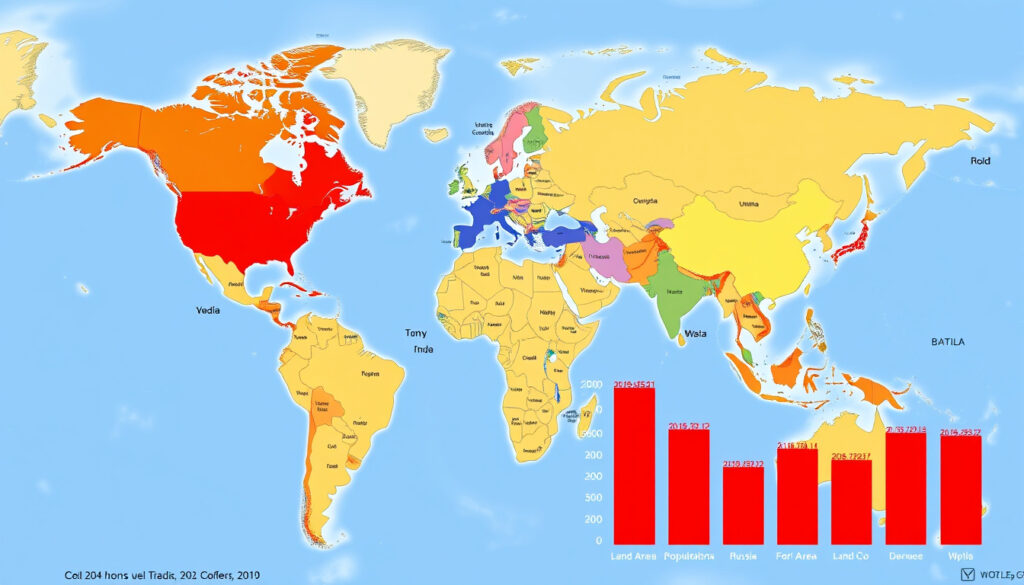
Biggest Country in the World: Rankings by Area and Population
When you ask someone to name the biggest country, most will say Russia — and they would be right, only if you are measuring by land area. The answer shifts completely when you factor in population, maritime territory, and how different sources count dependent territories.
Largest country by total area: Russia ·
Total area of Russia: 17,098,242 km² ·
Second largest country: Canada (9,984,670 km²) ·
Largest country by population: India (≈1.44 billion)
Quick snapshot
- Russia is the largest country by total area at 17.1 million km² (Britannica (editorial encyclopedia))
- Canada ranks second at 9.98 million km² (Britannica )
- India leads in population at over 1.4 billion (Worldometer (real-time data tracker))
- Which country ranks third by area — United States or China? The difference depends on inclusion of coastal waters and disputed territories (Worldometer (real-time data tracker))
- Whether overseas departments are counted (for example, France with French Guiana) (Britannica (editorial encyclopedia))
- Population figures vary significantly depending on the source and date of estimate (Worldometer (real-time data tracker))
- India overtook China as the world’s most populous country in 2022 (Statista (market and consumer data specialist))
- China entered population decline in 2023 (Statista)
- Population gap between India and China is expected to widen (U.S. Census Bureau (federal statistical agency))
- International measurement standards for land vs total area may be harmonised by the UN (U.S. Census Bureau (federal statistical agency))
Six key facts at a glance:
| Label | Value |
|---|---|
| Largest country | Russia |
| Russia total area | 17,098,242 km² |
| Second largest | Canada, 9,984,670 km² |
| Third largest (disputed) | USA (9,525,067 km²) or China (9,596,960 km²) |
| Largest by population | India |
| Population of largest country by area | ≈144 million (Russia) |
What is the biggest country in the world?
Russia’s total area
- Russia covers 17,098,242 km² according to Worldometer (real-time data tracker), making it nearly twice the size of Canada.
- That total includes inland lakes, rivers, and coastal waters. The land area alone is about 16.4 million km².
Russia’s land area
- When water bodies are subtracted, Russia still leads with roughly 16.4 million km² of land — larger than the entire continent of Antarctica.
- Its land area spans two continents: Europe and Asia, with about 77% of its territory in Asia.
Russia’s rank by population
- Despite being the largest by area, Russia ranks ninth in population globally, at about 144 million people (Worldometer).
- That gives it one of the lowest population densities among the top 20 countries. Russia’s density is just 8 people per km² (CIA World Factbook (U.S. intelligence agency)).
What are the top 10 biggest countries by area?
Top 10 from largest to smallest
- 1. Russia (17,098,242 km²)
- 2. Canada (9,984,670 km²)
- 3. United States (9,833,517 km² – Britannica includes coastal waters)
- 4. China (9,596,960 km²)
- 5. Brazil (8,510,418 km²)
- 6. Australia (7,741,220 km²)
- 7. India (3,287,263 km²)
- 8. Argentina (2,780,400 km²)
- 9. Kazakhstan (2,724,900 km²)
- 10. Algeria (2,381,741 km²)
Source: Worldometer (real-time data tracker)
Ranking discrepancies between sources
- Some sources rank China ahead of the United States because they exclude coastal waters (e.g., the Great Lakes and river deltas counted as part of U.S. total area).
- The U.S. Census Bureau and Worldometer use slightly different area figures, leading to third‑place swaps.
Inclusion of overseas territories
- If dependent territories are counted, countries like France (with overseas departments) would jump into the top 10. Most standard lists exclude dependencies.
Comparing the top five by area and population reveals a striking divergence:
| Country | Area (km²) | Population (2025 est.) |
|---|---|---|
| Russia | 17,098,242 | ~144 million |
| Canada | 9,984,670 | ~40 million |
| United States | 9,833,517 | ~347 million |
| China | 9,596,960 | ~1.416 billion |
| Brazil | 8,510,418 | ~218 million |
The pattern: the largest land masses are not the most populous. China packs ten times more people into less than two‑thirds of Russia’s land area.
Anyone selecting a country for investment, travel, or relocation must weigh area against population density: Russia offers empty space, China offers a massive workforce. The right choice depends on your goal.
Which countries have a population of over 1 billion?
India and China
- India is the world’s most populous country as of 2025, with 1,463,865,525 people according to Worldometer (real-time data tracker).
- China is second at 1,416,096,094 people per the same source.
- The U.S. Census Bureau’s population clock (federal statistical agency) puts India at 1,429,700,205 and China at 1,405,918,803.
Countries approaching 1 billion
- No other country has a population above 500 million. The next closest is the United States at about 347 million (Worldometer).
- Indonesia is fourth at ~286 million, followed by Pakistan at ~252 million.
Population vs area
- India is only the seventh largest by area, yet holds over 1.4 billion people — a density of about 460 people per km².
- By contrast, Russia’s density is just 8 people per km².
The implication: population density varies enormously even among large countries.
What is the largest country by population?
India vs China population ranking
- India surpassed China in 2022, according to Statista (market and consumer data specialist).
- Worldometer’s 2025 data shows India ahead by roughly 47.8 million people.
- The United Nations projects that India will remain the most populous country through at least 2050.
China’s population decline
- China’s population dropped in 2023 for the first time in decades, shrinking by about 2 million people (Statista).
- Low birth rates and an ageing population are expected to sustain the decline.
Population density of largest countries
- Among the top five area countries, the United States has the highest density (about 36 people per km²).
- India, though not in the top five area, has the highest density of any country over 1 million km².
Population figures fluctuate daily. Depending on the data source and the date of the estimate, the gap between India and China changes by millions. Always check the reference date.
The catch: anyone comparing statistics must verify the source’s timestamp to avoid outdated assumptions.
How is country size measured?
Total area vs land area
- Total area includes inland water bodies (lakes, reservoirs, rivers) and coastal waters up to the territorial sea baseline.
- Land area excludes all water. For most countries the difference is small, but for Canada (with its many lakes) total area is about 9% larger than land area.
Exclusive economic zones (EEZs)
- Maritime EEZs extend 200 nautical miles from the coast, but they are not counted toward country area in standard rankings.
- If EEZs were included, countries like the United States and France would leap in rank because of their Pacific territories.
Disputed territories
- Area figures for some countries are disputed. For example, China includes Taiwan, Tibet, and Aksai Chin in its official area, while other sources do not.
- Kashmir is claimed by both India and Pakistan; its inclusion changes the area of both countries.
The variation between sources stems from two things: what water you count and whose land you recognise.
— Editors at Britannica (editorial encyclopedia)
Our real‑time counter updates every second. The country with the biggest population today may not be the biggest tomorrow.
— Worldometer (real-time data tracker)
Teaching geography means showing students that numbers depend on definitions. Ask them first: biggest by what measure?
For anyone comparing country sizes on a map or spreadsheet, the takeaway is clear: always check whether the figure includes coastal waters and whether dependencies are counted. Ignoring those details can flip the rankings entirely. Geography students must remember: the choice of measurement is the difference between a correct answer and a misleading one.
For a detailed breakdown of Russia’s 17.1 million km² claim, see this Ireland Analysis report on Russias size.
Frequently asked questions
What is the smallest country in the world?
Vatican City is the smallest independent state, with an area of about 0.44 km².
Is Russia bigger than Pluto?
No. Pluto has a surface area of about 17.6 million km², slightly larger than Russia’s 17.1 million km².
How many countries are there in the world?
The United Nations recognises 195 member states. Including observer states and dependencies, the total is around 230.
Does the largest country have the largest economy?
No. The United States has the largest economy (GDP about $27 trillion), far exceeding Russia’s (~$2 trillion).
What is the largest country by land area (excluding water)?
Russia still leads, with about 16.4 million km² of land. Canada is second at roughly 9.1 million km².
How does Antarctica compare to countries in size?
Antarctica covers about 14 million km², making it larger than China, the USA, and Brazil combined.
Which US state is the largest and how does it compare to countries?
Alaska is the largest US state at 1.72 million km² — about the size of Kazakhstan (9th largest country).
More related posts
 BBC Weather Newton Mearns – Today, Tomorrow & 14-Day Forecast
 The Magic of Ordinary Days – Book Summary, Movie Guide & Facts
 2 Seater Recliner Sofa – Compact UK Deals and Specs
 Contract Phones No Upfront Cost Ireland – Best €0 Deals
 Ella Langley Biography: Career, Faith, and Riley Green
 Ratatouille (Film) – Plot, Cast and Key Facts
 Sarah Catherine Hook Movies and TV Shows: Full Filmography
 Celtic v St Mirren: 6-2 Scottish Cup Semi Result & Guide