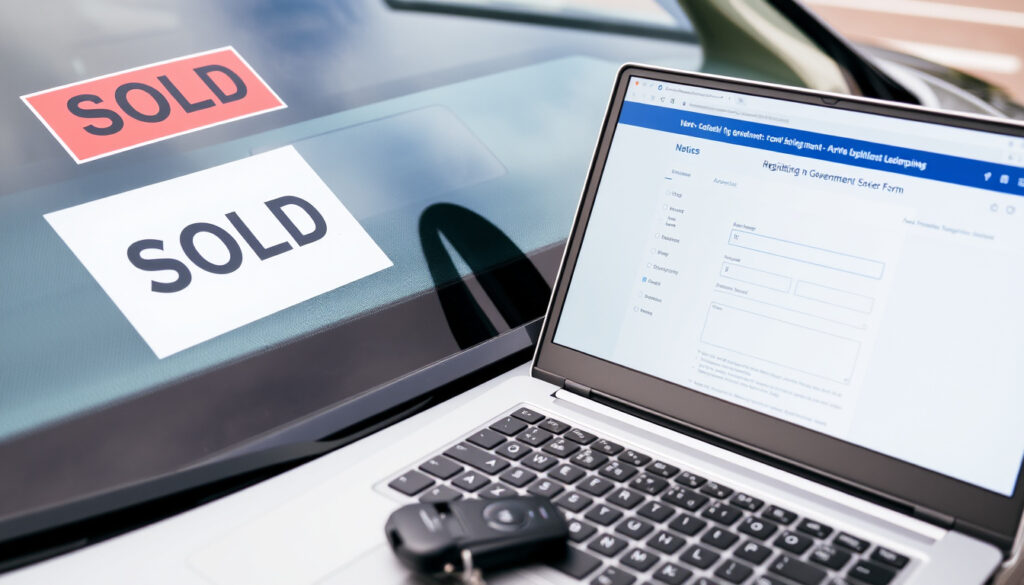
DVLA Sold My Car? Notify Online Now Step-by-Step Guide
Selling your car is only half the story—the other half is notifying DVLA to protect yourself from fines and tax headaches. Each year, DVLA processes roughly 7.3 million vehicle sale notifications, and this guide covers the exact steps to avoid a £1,000 penalty.
Vehicles notified as sold to DVLA per year: 7.3 million (2023, DVLA) ·
Time to process online notification: Immediate; letter confirmation within 5 working days ·
Penalty for not notifying DVLA of sale: Up to £1,000 fine ·
V5C/3 yellow slip reference digits: 11 ·
Online service availability: 24/7
Quick snapshot
- You must notify DVLA when you sell or transfer a vehicle (GOV.UK (UK government motoring agency))
- Online notification is free and immediate (GOV.UK (UK government motoring agency))
- Tax refund is automatic after notification (GOV.UK (UK government motoring agency))
- Exact time for V5C postal delivery varies by Royal Mail (GOV.UK (official guidance))
- Whether a private sale without V5C/3 is possible in all cases (GOV.UK (official guidance))
- Day of sale: online notification triggers immediate record update; buyer receives green slip (V5C/2) (Inside DVLA blog (official DVLA communications))
- Within 5 working days: new V5C arrives for buyer; seller receives confirmation and any tax refund (GOV.UK (UK government motoring agency))
- If not notified within 14 days: potential fine up to £1,000 (GOV.UK (UK government motoring agency))
Notify DVLA online within minutes of handing over the keys and you transfer liability instantly. A delay of even a few days can leave you on the hook for the buyer’s parking fines or speeding tickets.
Five key facts about notifying DVLA show why it matters:
| Label | Value |
|---|---|
| Legal requirement to notify DVLA | Yes, under the Vehicle Excise and Registration Act 1994 (GOV.UK) |
| Online service availability | 24/7, 365 days a year (GOV.UK) |
| Time to get new V5C for keeper | Typically 5 working days (GOV.UK) |
| Tax refund after sale | Automatic if you notify DVLA; refunded to seller (GOV.UK) |
| Penalty for not notifying | Up to £1,000 fine (GOV.UK) |
The implication: these figures underline the importance of acting fast after a sale.
How do I tell DVLA I have sold my car?
Steps to notify DVLA online
The fastest route is the GOV.UK online service. You’ll need your V5C log book and the 11-digit document reference number from it. Here’s the process:
- Go to GOV.UK and select “Sold, transferred or bought a vehicle”.
- Enter the vehicle registration number and the 11-digit reference from your V5C. Inside DVLA (official blog) confirms this reference is essential.
- Provide the exact date of sale and the new keeper’s full name and address (no initials). Inside DVLA notes that using only initials will cause delays.
- If selling to a dealer, enter the trader’s name and postcode; a drop-down will confirm the address. Carwow (UK car buying platform) details this step.
- Submit and you’ll receive an immediate online confirmation. DVLA updates the vehicle record instantly.
What information you need
Before starting the online form, gather:
- Your V5C log book with the 11-digit reference number. GOV.UK states you can only use the online service if you still have the log book.
- The car’s registration number and exact date of sale.
- Full name and address of the new keeper (or motor trader).
- An email address for your confirmation receipt. Carwow notes the form asks for this.
What to do with the V5C/3 yellow slip
After submitting online, the V5C/3 (new keeper supplement) is generated. Tear it off and hand it to the buyer. They need it to tax the car before driving. Inside DVLA emphasises giving the green slip (V5C/2) so the new keeper can tax immediately. The remaining log book should be kept for your records.
The pattern: speed here directly reduces seller risk.
Can I transfer ownership of a car online?
Online vs postal transfer
Yes, you can transfer ownership entirely online. The GOV.UK service handles sales to private buyers and motor traders. The online route is free, instant, and updates the DVLA record immediately. Postal transfer (sending the V5C to DVLA, Swansea, SA99 1BA) takes longer and requires your log book to be posted. If you’ve already posted the V5C, you cannot use the online service and must write instead. GOV.UK warns: “You can only use this service if you have not already sent your log book by post.”
What is the new keeper supplement
The V5C/3 (sometimes called the new keeper supplement) is the tear-off section at the bottom of the log book. It contains the new keeper’s details and a document reference. When you notify online, the supplement is generated automatically. The buyer receives a green slip (V5C/2) to tax the vehicle immediately. The full new V5C arrives by post within 5 working days. GOV.UK confirms the timeline.
The implication: online transfer is the most secure method because the record updates in real time, removing any doubt about who is liable for the vehicle.
If you’ve already sent the log book by post, you lose the convenience of online notification. You’ll need to write to DVLA with the sale date and new keeper details — and wait for confirmation.
What this means: always verify you still hold the V5C before starting online.
How long does change of ownership take online?
Immediate online confirmation
When you submit the online form, DVLA updates the vehicle record in real time. You receive an emailed confirmation immediately. GOV.UK states the change is effective from the moment of submission. This means the seller’s liability ends at that point.
When the new keeper gets the log book
The new keeper’s V5C is sent by second-class post. GOV.UK says it arrives within 5 working days. Meanwhile, the buyer can drive using the green slip (V5C/2) as proof of ownership, provided they tax and insure the car. WeBuyAnyCar (UK car buying service) notes the online route is the quickest way to complete the process.
The pattern: immediate digital update, followed by a postal delivery that can vary by a day or two due to Royal Mail.
Do I have to back tax a car I just bought?
Vehicle tax rules for new owners
Yes, as the new keeper you must tax the vehicle before using it on public roads. The moment the seller notifies DVLA, the vehicle’s tax is cancelled and any full months remaining are refunded to the seller. GOV.UK states: “After you tell DVLA, the vehicle tax is cancelled and any full months remaining are refunded.” The buyer cannot drive without taxing first.
How to tax your car online
Taxing is quick and can be done immediately after the seller notifies DVLA. Use the green slip (V5C/2) reference number on the GOV.UK vehicle tax service. You’ll need the 12-digit reference from the green slip, the vehicle registration, and payment if needed. The minimum six months rule applies to some vehicles. If you buy from a dealer, they may tax it for you as part of the sale.
The catch: failing to tax can cost more than the tax itself. To avoid fines and penalty points, buyers must tax the car before driving, and the seller’s green slip makes this possible immediately, but you can learn more about how to report the sale of your car to the DVLA at $Повідомити DVLA про продаж автомобіля.
Is it better to scrap or sell my old car?
Upsides
- Selling privately can yield 20–40% more than scrapping
- Selling to a dealer is faster and requires less paperwork
- Scrapping is quickest and requires no buyer interaction
Downsides
- Private sale needs more time, adverts, and negotiation
- Dealer offers are often lower than private sale prices
- Scrapping usually pays only a few hundred pounds at most
The decision hinges on your priority: maximum cash or minimum hassle. If the car is worth less than £500 or has serious damage, scrapping is often the simpler route. For cars in good condition, a private sale typically puts more money in your pocket. Either way, you must notify DVLA — even if you scrap it. GOV.UK covers notification for scrapping: tell DVLA online or by post with the date of disposal.
The trade-off: more money (private) vs less effort (scrap). The one common step: notifying DVLA whichever route you choose.
Timeline: What happens after you notify DVLA
- Day of sale: You notify DVLA online. The record updates instantly. The buyer receives the green slip (V5C/2). Inside DVLA confirms the immediate update.
- Within 5 working days: The new V5C arrives for the buyer. The seller receives a confirmation letter and any tax refund. GOV.UK sets this timeframe.
- If not notified within 14 days: The seller risks a fine up to £1,000. DVLA may also hold the seller liable for congestion charges or parking tickets incurred by the buyer. GOV.UK states the penalty.
What this means: every day of delay increases seller exposure.
What we know vs what’s unclear
Confirmed facts
- You must notify DVLA when you sell or transfer a vehicle (GOV.UK)
- Online notification is free and immediate (GOV.UK)
- Tax refund is automatic after notification (GOV.UK)
- The online service requires the V5C 11-digit reference (Inside DVLA)
- Failure to notify can result in a fine of up to £1,000 (GOV.UK)
What remains unclear
- Exact delivery time for the V5C by post — depends on Royal Mail (GOV.UK)
- Whether a private sale can proceed without any V5C document in all circumstances (GOV.UK)
What the experts say
“The online service is the fastest and most secure way to tell us you’ve sold your vehicle. Just make sure you have the 11-digit reference from your V5C to hand.”
Inside DVLA blog (official DVLA communications)
“You must tell DVLA immediately after the sale or transfer. If you do not, you could be fined up to £1,000 and still be liable for the vehicle.”
GOV.UK (UK government motoring agency)
For UK car sellers, the choice is clear: notify DVLA online within minutes of the handover, or risk fines up to £1,000 and lingering liability. Buyers, meanwhile, must tax the car before driving using the green slip. The online notification service is free, instant, and the only step that shifts responsibility properly. Sellers who delay face real consequences—act immediately to protect yourself.
Related reading: Car for Sale Near Me: Ireland’s Best Sites & Deals · NFU Mutual Car Insurance: Is It a Good Buy
If you’ve recently sold your vehicle, you can follow a similar process for notifying the DVLA after selling your car to ensure you’re protected from liability.
Frequently asked questions
Can I sell a car without a V5C log book?
Yes, but you cannot use the online service. You must write to DVLA at Swansea, SA99 1BA, providing the vehicle registration, make, model, date of sale, and the new keeper’s name and address. GOV.UK explains the process.
Do I need to tell DVLA if I scrap my car?
Yes. You must notify DVLA that the vehicle has been scrapped, even if you’re not transferring ownership. The same online service or postal route applies. GOV.UK covers disposal.
What is a V5C/3 new keeper supplement?
It’s the tear-off section at the bottom of the log book. When you notify DVLA online, this supplement is generated. The buyer gets a green slip (V5C/2) to tax the vehicle. Inside DVLA explains its use.
How do I know if DVLA has processed my notification?
Online notification gives immediate on-screen confirmation and an email receipt. If you notify by post, DVLA sends a letter within 5 working days. GOV.UK confirms the process.
Can I drive a car before the V5C arrives?
Yes, if you have the green slip (V5C/2) from the seller, you can tax the car and drive immediately. The full V5C should arrive within 5 working days. GOV.UK vehicle tax service allows taxing with the green slip reference.
What happens if the buyer does not tax the car?
The seller remains liable if they have not notified DVLA. Once notification is processed, the buyer is responsible. GOV.UK states the seller’s liability ends only when DVLA is told.
More related posts
 Out of Office Message – Clear and Professional Templates
 How to Get to Sleep Fast with NHS and Mayo Clinic Tips
 Jasmine Al-Fayed: Age, Husband, Net Worth & Family Legacy
 Cast of Black Work: Full Actors List & Characters (2015)
 Harry Potter and the Cursed Child Movie – 2026 Rumors Debunked
 Kendrick Lamar Not Like Us: Feud, Lyrics & Super Bowl
 UK News The Sun: Headlines, History, and Today’s Top Stories
 Emma Grede Net Worth 2025: $405M From Skims & More