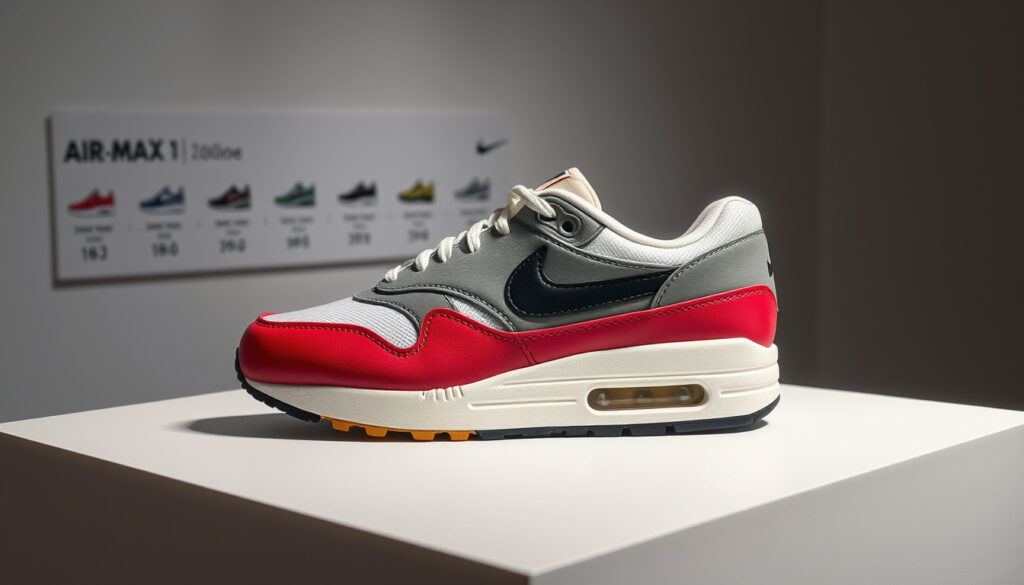
Nike Air Max 1: History, Value, and 2025 Buying Guide
Few sneakers have managed to stay relevant for nearly four decades the way the Nike Air Max 1 has, designed by Tinker Hatfield and released on March 26, 1987, as the first shoe to put Nike’s Air cushioning on display — a design choice inspired by the Centre Pompidou in Paris (Nike (official brand history)). Today, 37 years later, the Air Max 1 still commands attention in sneaker rotations, on resale markets, and in Nike’s retro lineup, and this guide breaks down its history, current standing, and which models make sense for your wallet in 2025.
Release year: 1987 ·
Designer: Tinker Hatfield ·
Original retail price: $65 ·
First visible Air unit: Yes ·
Retro releases: Ongoing since 2001
Quick snapshot
- Air Max 1 was released in 1987 (Highsnobiety (sneaker culture publication)).
- Nike currently produces Air Max 1 models (Nike (official store)).
- Tinker Hatfield designed the shoe (Wikipedia (community encyclopedia, tier3)).
- Exact resale values fluctuate rapidly; use current market data.
- Future production plans are not publicly disclosed.
- Official annual production numbers are not released.
- 1987: First visible Air unit changes sneaker design forever (Sneaker Freaker (sneaker magazine)).
- 2005: Atmos “Elephant” collaboration becomes a grail (SPORTSHOWROOM UK (sneaker retail and media)).
- Continued retro releases and collaborations expected (Nike (official store)).
- Resale demand for rare pairs likely to stay strong. (Nike (official store))
Here are the key specifications of the Air Max 1 at a glance.
| Year introduced | 1987 |
| Designer | Tinker Hatfield |
| Original price | $65 |
| First visible Air unit | Yes |
| Latest retro | 2024 |
| Rare pair resale | Atmos Elephant: $500–$1,000+ |
Does Nike still make Air Max 1?
Nike has not discontinued the Air Max 1. It remains in production in both general-release and limited-edition runs. The official Nike website and authorized retailers carry current models, though collaborations and special editions often affect availability (Nike (official brand history)).
Buyers looking for new pairs in 2025 have options: standard colorways are fairly easy to find, but hyped collabs sell out within minutes.
Current production status
- The Air Max 1 is still in Nike’s active catalog as of 2025 (Nike (official store)).
- No official discontinuation announcement has been made.
Recent retro releases
- Nike has retroed the Air Max 1 in multiple colorways every year since 2001 (SPORTSHOWROOM UK (sneaker retail and media)).
- 2024 saw the “Big Bubble” anniversary pack and several OG-style drops.
Where to buy new pairs
- Nike.com, Finish Line, Foot Locker, and other major retailers.
- Secondary markets like StockX and GOAT for sold-out editions.
The takeaway: if you want a fresh pair, you can still grab one — but the clock ticks fast on limited editions.
When did the Air Max 1 come out?
The Nike Air Max 1 debuted on March 26, 1987, as the first Nike shoe to expose the Air-Sole unit (Wikipedia (community encyclopedia, tier3)). It was designed by Tinker Hatfield, who drew inspiration from the Centre Pompidou in Paris — a building that famously turns its structural systems inside out (SPORTSHOWROOM UK (sneaker retail and media)).
Original launch year and context
- The first production run used mesh uppers and synthetic suede overlays (SPORTSHOWROOM UK (sneaker retail and media)).
- It appeared in Nike’s first television ad the same year (sneaker.de (German sneaker media)).
Design by Tinker Hatfield
- Hatfield was a track-and-field coach turned designer (Wikipedia (community encyclopedia, tier3)).
- He wanted the Air cushion to be visible, not hidden in the midsole (Crep Protect (sneaker care brand)).
Milestone in visible Air technology
- Previous Air technology (Air Tailwind, 1978) was concealed (SPORTSHOWROOM UK (sneaker retail and media)).
- The Air Max 1’s window was later downsized for durability (sneaker.de (German sneaker media)).
The pattern: Hatfield’s decision to expose the technology — borrowed from architecture — turned a running shoe into a cultural object.
Is the Nike Air Max 1 good?
Reviewers consistently praise the Air Max 1 for its classic comfort and style. The shoe uses a visible Air-Sole unit in the heel, providing a firm but supportive cushion suited for all-day wear (RunRepeat (independent review aggregator) cut-in-half analysis). However, opinions are mixed on durability of the suede and mesh panels.
Comfort and cushioning
- The Air unit sits in the heel; forefoot has foam (Highsnobiety (sneaker culture publication)).
- Supportive enough for light walking, but not for high-impact running.
Durability and materials
- Mesh uppers breathe well but can tear over time (SPORTSHOWROOM UK (sneaker retail and media)).
- Suede overlays need care to avoid staining.
Versatility for casual wear
- Pairs with most outfits — jeans, joggers, shorts.
- Not designed for performance sports; strictly lifestyle now.
Overall, the Air Max 1 delivers style and moderate comfort but is not a performance shoe.
Are Air Max 1 still popular today?
Absolutely. The Air Max 1 remains a staple in sneaker rotations worldwide. Collaborations with Atmos, Patta, and others drive ongoing hype, and resale prices for rare pairs indicate sustained demand (Sneaker Freaker (sneaker magazine)).
Cultural relevance and sneaker community
- Nike Air Max Day (March 26) celebrates the line globally.
- It appears in street style photos, music videos, and collector shows.
Collaborations and limited editions
- Atmos “Elephant” (2005) and Patta “Cherrywood” are among the most sought-after (Sneaker Freaker (sneaker magazine)).
- Brands like Clot, Undefeated, and Parra have also collaborated.
Resale market interest
- General releases trade below retail; limited editions often double or triple.
- StockX data shows consistent transaction volume for the Air Max 1.
The implication: the Air Max 1 isn’t just nostalgic — it’s a live, breathing part of sneaker culture in 2025.
Which Nike Air Max are really worth their money in 2025?
Three models dominate the conversation: Air Max 1, Air Max 90, and Air Max 95. Each offers a different balance of style, comfort, and cost.
Three models, one pattern: the Air Max 1 gives the best blend of iconic design and moderate price, while the 90 and 95 trade more cushioning for a heavier look.
| Model | Release year | Typical price (2025) | Cushioning | Style | Resale potential |
|---|---|---|---|---|---|
| Air Max 1 | 1987 | $120–$150 | Heel Air unit, firm | Low-top, slim | Moderate (limited editions high) |
| Air Max 90 | 1990 | $130–$160 | Full heel Air, plus forefoot foam | Low-top, chunkier | Lower (more produced) |
| Air Max 95 | 1995 | $160–$190 | Full-length Air, visible pods | Mid-top, layered | Moderate (nostalgia driven) |
The catch: if you want a sneaker that works with most wardrobes and still has collector upside, the Air Max 1 is the safest bet. If you prioritize cushioning for long walks, the 90 or 95 may serve you better.
Do Nike Air Max hold their value?
General-release Air Max 1s depreciate after purchase, but limited collaborations can hold — and sometimes increase — in value. Rare colorways like the Atmos “Elephant” and Patta “Cherrywood” regularly sell for $500–$1,000+ on secondary markets (Sneaker Freaker (sneaker magazine), StockX (resale marketplace)).
Factors affecting resale value
- Condition (deadstock vs. worn), box and extras, rarity, and collaboration tier.
- Market hype cycles — Air Max Day bumps demand temporarily.
Most valuable Air Max 1 colorways
- Atmos “Elephant” (2005, 2016 retro)
- Patta “Cherrywood” (2007)
- UNDEFEATED “Blackout” (2005)
Comparison with other Nike retro models
- Air Max 1 limited editions often outperform Dunks and Air Force 1s in percentage appreciation.
- However, they are less liquid than Yeezy or Jordan 1 resale markets.
What this means: for collectors, the Air Max 1 offers strong potential, but only if you buy the right collaboration and keep it pristine.
Upsides
- Timeless design that never goes out of style
- Moderate price for a lifestyle icon
- Strong community and collector culture
- Wide availability of general releases
Downsides
- Not a performance running shoe
- Durability concerns with mesh and suede
- General releases depreciate immediately
- Sizing can be inconsistent across colors
Timeline: key moments in Air Max 1 history
- – Nike Air Max 1 released, designed by Tinker Hatfield (Nike).
- – Original model discontinued; retro culture begins (Sneaker Freaker).
- – First official retro release in limited quantities (Sneaker Freaker).
- – Atmos collaboration (Elephant) released, becomes grail (Sneaker Freaker).
- – 30th anniversary with multiple special editions (Sneaker Freaker).
- – Continued retros and collaborations; model remains in production (Sneaker Freaker).
What we know for sure
- Air Max 1 was released in 1987 (Highsnobiety).
- Nike currently produces Air Max 1 models (Nike).
- Tinker Hatfield designed the shoe inspired by Centre Pompidou (Nike).
What’s uncertain
- Exact resale values fluctuate rapidly; use current market data.
- Future production plans are not publicly disclosed.
- Official annual production numbers are not released.
What the experts say
I looked at the Centre Pompidou building in Paris and thought, what if we revealed the Air cushion the same way?
— Tinker Hatfield, Nike designer (cited by Nike)
The Air Max 1 isn’t just a shoe; it’s the start of a whole category of visible cushioning that changed how people think about sneaker technology.
— Sneaker Freaker (sneaker magazine), A Brief History of the Nike Air Max 1
From a comfort perspective, the Air Max 1 holds up for casual wear, but the cushioning is dated compared to modern foam and Air setups.
— RunRepeat (independent review aggregator), cut-in-half analysis
Thirty-seven years in, the Nike Air Max 1 is no museum piece — it’s a living benchmark for design and cultural endurance. For the buyer in 2025, the choice is clear: pick a general-release colorway for daily style at $120, or hunt a limited collaboration if you want a sneaker that may actually gain value. Either way, you’re buying a piece of sneaker history that still feels fresh.
For those interested in a particular iteration, the specific Air Max 1 colorway offers a detailed breakdown of its design and sizing.
Frequently asked questions
How much do Nike Air Max 1 cost in 2025?
General releases retail for $120–$150. Limited collaborations can reach $300 at retail and $500–$1,000+ on secondary markets.
Are Nike Air Max 1 comfortable for all-day wear?
Yes, for casual daily wear. The heel Air unit provides good shock absorption, but the foam forefoot is firmer than modern full-length Air units.
How do Nike Air Max 1 fit compared to other Nikes?
They generally fit true to size, though some narrow-footed wearers prefer half a size down. If you have wide feet, consider going half a size up.
What are the most popular Nike Air Max 1 colorways?
OG “University Red” (1987), Atmos “Elephant”, Patta “Cherrywood”, and the “Big Bubble” 2024 release.
How can I clean and maintain my Air Max 1?
Use a soft brush with mild soap and water. Avoid machine washing. Protect suede panels with a waterproof spray.
Are new Air Max 1 releases limited or general release?
Most colorways are general release, but collaborations and special editions are limited and often sell out quickly.
What is the difference between Air Max 1 and Air Max 90?
The Air Max 90 is chunkier, has more visible Air volume, and was designed for higher-impact running. The Air Max 1 is sleeker and more casual.
Related reading: Birthday Dress for Women: 2025 Styles & Buying Guide · Michael Kors Bags Sale Ireland: Best Deals & Outlets
More related posts
 Long Island Iced Tea: Recipe, Alcohol Content & History
 The Snail and the Whale: Story, Moral, Age, and Species
 Cast of The Better Sister: Banks, Biel, Stoll & Full List
 British and Irish Lions 2025 – Schedule Results Tickets Guide
 How to Get Daily Mail Classic Homepage UK (2025)
 Canal Boat for Sale: Ireland, UK & Scotland
 Julie Bowen Happy Gilmore: Role, Age, Illness & Return
 Tell Me Who I Am: Netflix Twins Documentary Explained