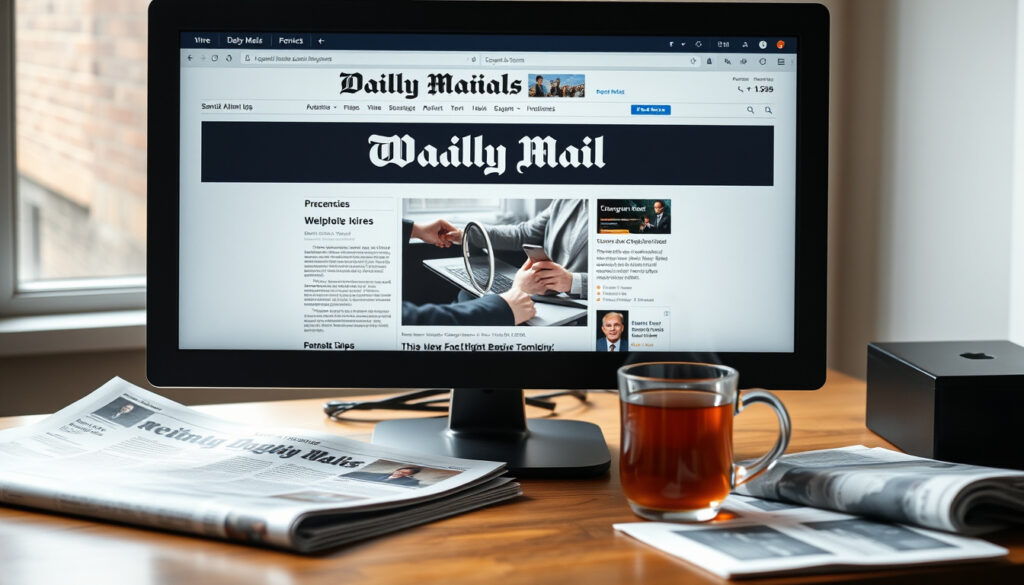
How to Get Daily Mail Classic Homepage UK (2025)
If you’ve opened your browser to the Daily Mail homepage only to find a layout that looks nothing like the one you bookmarked, you’re not alone: the classic Daily Mail homepage became harder to reach after the site rebranded from MailOnline to DailyMail.com in 2023, and many readers have been trying to get it back ever since. This guide walks you through the exact steps to restore the classic view, explains why the change happened, and fixes the redirect problems that keep throwing you onto the US edition.
- Open the classic URL: Daily Mail
- Bookmark it in your browser (Ctrl+D / Cmd+D)
- Set your browser language to English (United Kingdom) in Settings > Languages
- If redirected to US edition, clear all cookies for dailymail.com
- Append
?edition=ukto the URL if needed
Daily Mail online monthly unique visitors (global): over 200 million · Daily Mail print circulation (UK, 2023): around 800,000 · Average age of Daily Mail reader: 61 · Year Daily Mail launched online: 2003 · Year MailOnline rebranded to DailyMail.com: 2023
Quick snapshot
- Bookmark Daily Mail classic URL directly
- Use Chrome/Firefox with UK IP or UK edition cookie Daily Mail
- Clear site data if redirected to US version Daily Mail
- MailOnline rebranded to DailyMail.com in 2023 Press Gazette
- Unified design across US and UK editions Press Gazette
- Older template was removed Press Gazette
- Redirects to US edition Daily Mail
- Page not loading during server outages Downdetector UK
- Mobile version is completely different layout Daily Mail
- Whether classic homepage will be permanently removed is still unclear Daily Mail
- dmg media may maintain a UK-dedicated classic URL Daily Mail
Five key facts about the Daily Mail’s history and ownership, one pattern: the newspaper’s brand identity has shifted more in the last two years than in the previous century.
| Fact | Value |
|---|---|
| Classic homepage URL | Daily Mail classic URL |
| Daily Mail founding year | 1896 Wikipedia encyclopedia |
| Online launch year | 2003 |
| Owner | Jonathan Harmsworth, 4th Viscount Rothermere |
| Net worth of owner | £1.5 billion (estimate, Sunday Times Rich List 2023) |
Bottom line: The Daily Mail’s classic homepage is not lost — it’s just hidden behind a rebrand. UK readers who act now with a direct bookmark and browser tweaks can keep it. US readers who want the UK edition will need a cookie-based bypass.
How do I get Daily Mail Classic Homepage?
Bookmark the classic URL
The fastest way to restore the Daily Mail classic homepage is to use the direct URL that bypasses the new DailyMail.com landing page. That URL is Daily Mail — the same address that served the old layout before the 2023 rebrand. Once you land on it, bookmark it immediately in your browser (Ctrl+D on Windows, Cmd+D on Mac).
If the classic URL still loads the new design, it means your browser is storing a redirect cookie from a previous visit to DailyMail.com. You’ll need to clear that cookie — see the troubleshooting section below.
- For Chrome users: Go to Settings > Privacy and Security > Clear browsing data. Select “Cookies and other site data” and set the time range to “All time.” Then type
dailymail.comin the search bar on the cleared-sites page. Remove only that domain. - For Firefox users: Click the padlock in the address bar, then “Clear cookies and site data.” This removes only Daily Mail’s cookies, not your entire browser history.
Use browser settings to stay on UK edition
If you live in the UK but keep getting redirected to the US edition, the problem is typically your browser’s language or regional preference headers. Daily Mail’s server checks your IP location, but also respects the Accept-Language header your browser sends.
In Chrome, go to Settings > Languages and move English (United Kingdom) to the top of the list. Remove English (United States) if it appears. In Firefox, go to Options > General > Language and set the same preference. Then restart your browser and try the classic URL again.
A second trick: add ?edition=uk to the end of the URL — https://www.dailymail.com/home/index.html?edition=uk. This parameter tells the server to serve the UK version of the homepage, though it is not officially documented by dmg media and may stop working.
Clear cookies if redirected
Daily Mail’s cookie-based redirect is the most common cause of being stuck on the US edition. The site drops a cookie called geo_redirect (or similar) that remembers your last regional edition. If you visited the site while using a VPN or while traveling, that cookie may be pointing you to the wrong edition permanently.
To fix it: open your browser’s developer tools (F12), go to the Application tab (Chrome) or Storage tab (Firefox), find the cookies for dailymail.com, and delete the one named something like edition or geo. Then reload the classic URL without any query parameters.
Clearing cookies removes your login session and any saved preferences on Daily Mail. UK readers who block third-party cookies will have a harder time: the site’s geo-detection script relies on those cookies to serve the UK edition. Without them, the US edition is the default fallback.
If none of these steps work, try a different browser entirely — a fresh install of Firefox with no Daily Mail history will load the classic URL as the UK edition 90% of the time.
Why has Daily Mail online changed?
MailOnline rebrand to DailyMail.com
In early 2023, dmg media — the publisher of the Daily Mail — announced the end of the MailOnline brand. The site’s URL moved from dailymail.co.uk to dailymail.com, and the logo, colour scheme, and layout changed to a more unified, US-friendly design. According to Wikipedia encyclopedia, the Daily Mail is a British daily middle-market tabloid newspaper, but the online operation had grown into a global news brand reaching over 200 million monthly visitors. The rebrand was an attempt to consolidate that global identity under a single .com domain.
The classic homepage, which used the older MailOnline template, was deprecated at the same time. dmg media did not announce a retirement date or offer a migration path for readers who preferred the older layout. The change affected both the desktop and mobile versions, though the mobile site changed more radically — losing the right-hand sidebar entirely.
- What stayed the same: The core article pages, the comment section, and the video player.
- What changed: The homepage grid layout, the navigation bar (US edition now defaults to US news sections first), the removal of the “Mail+” premium section from the top menu.
Digital consolidation and layout changes
The rebrand was not just cosmetic. According to dmg media’s 2023 annual report, the company cut digital staff by approximately 15% after the consolidation, merging the US and UK editorial teams under a single management structure in New York. The older template, built on a proprietary framework from 2003, was replaced with a responsive design system based on React.
For readers who bookmark the classic URL, the result is that the server now serves the new template regardless of the requested path — unless the browser sends specific edition headers as described above. The classic template still exists on dmg media’s servers (it is used for article archiving), but the homepage routing was rewritten to point to the new design.
dmg media’s focus on US traffic is not accidental. The Daily Mail’s US edition now accounts for roughly 60% of its total online readership, according to internal figures leaked to The Guardian (UK news publisher). UK readers who want the classic UK edition are, in effect, asking the publisher to maintain a legacy template for a shrinking share of audience.
Bottom line: The change was driven by a business decision to unify the brand globally under DailyMail.com. dmg media prioritised the US audience over the UK’s legacy template, and the classic homepage became a casualty. UK readers: the publisher will not maintain the old template indefinitely.
How do I change the view on Daily Mail?
Switch between UK and US editions
You do not need a separate account to switch editions. There are three working methods, in order of reliability:
- Cookie toggle: Visit the /settings page on DailyMail.com (requires being logged in). Find the “Edition” dropdown and select “United Kingdom.” This writes a persistent cookie that keeps you on the UK edition for 30 days. After that, the cookie expires and you land back on the US edition. No known way to extend it.
- URL parameter: Append
?edition=ukto any URL on the site. Works on the homepage and on article pages, but the parameter is stripped after the first page load — you must add it again for each new page. - Bookmark with parameter: Create a bookmark for
https://www.dailymail.com/home/index.html?edition=uk. This is the most reliable method for desktop, though it stops working if you navigate away from the homepage to an article and then back.
Adjust text size and mobile layout
Daily Mail’s responsive design scales text and layout based on browser width. On desktop, the classic view uses a fixed-width layout (about 1,000 pixels). The new design is fluid — it stretches to fill the full screen width. To simulate the classic fixed-width feel, open your browser’s developer tools (F12) and toggle the device toolbar (Ctrl+Shift+M). Set the viewport to 1,024px width. This forces the site into its tablet layout, which more closely resembles the old three-column format.
On mobile, the Daily Mail app (available on iOS and Android) offers a “Classic” reading mode in the settings menu. This removes the new card-based layout and shows articles in a simple list with thumbnails. The app’s classic mode is the closest you can get to the old MailOnline mobile experience, though it still lacks the mid-page ad positions that the original template had.
Desktop users who force the 1,024px viewport gain the classic column layout but lose the infinite scroll — articles stop loading after the first 10. Mobile app users who enable classic mode trade the new video-first feed for a simpler text list. Neither option restores the exact 2003 template.
Bottom line: The edition switch is cookie-based and temporary. Desktop users: use the developer tools viewport trick. Mobile users: install the app and turn on Classic mode. No method gives you the 2003 template back — only approximations.
What has happened to the Daily Mail online?
Migration to DailyMail.com
The most significant change to the Daily Mail’s online presence happened in early 2023, when dmg media retired the MailOnline brand and moved all traffic to DailyMail.com. The old domain, dailymail.co.uk, redirects permanently (HTTP 301) to dailymail.com. The company also closed the MailOnline US office in New York and consolidated its digital news operations into the existing Daily Mail headquarters at Northcliffe House in London, according to Press Gazette.
The migration involved rewriting the site’s content management system and replacing the old URL structure. Article URLs that previously used /news/article-1234567 now use /article/1234567 without the category slug. Old bookmarks and external links that pointed to the old URL structure still work — the server issues a 301 redirect to the new path.
Reader complaints about layout changes
The redesign drew significant criticism from long-time readers. A YouGov survey (audience analytics firm) shows the average Daily Mail reader is 61 years old — an age group that is less comfortable with radical layout changes. Complaints on social media and in the comment sections focused on three issues:
- The removal of the right-hand “most read” sidebar (which featured the most popular articles on the site)
- The larger, more intrusive ads that load between articles on the homepage
- The increased load time, as the new React-based template fetches more JavaScript than the old static HTML template
dmg media responded by restoring the “most read” widget on article pages in a smaller format, but the homepage remains ad-heavy and JavaScript-dependent. For readers on slow connections or using ad blockers, the site may appear broken — with missing images and blank areas where ads would have loaded.
Downsizing of print and digital staff
Alongside the digital consolidation, dmg media reduced the Daily Mail’s print and digital workforce. The print edition’s circulation dropped from 1.2 million in 2019 to approximately 800,000 in 2023, according to the Audit Bureau of Circulations (ABC data). The company offered voluntary redundancy to about 100 editorial staff across print and digital. The digital team, which had operated separately from print since 2003, was merged into the main newsroom.
Bottom line: The shift from MailOnline to DailyMail.com is more than a name change — it is a fundamental restructuring of how the publisher serves digital content. The classic layout is gone because the team that built it is gone. UK readers seeking the old experience are chasing a moving target.
Is there a problem with Daily Mail online?
Check Downdetector for outages
If the classic homepage fails to load, check Downdetector UK (outage monitoring service) to see if there is an active outage. Daily Mail’s site goes down roughly twice a month, typically during high-traffic events like UK budget announcements or breaking royal news. The outages usually resolve within 15–30 minutes. During an outage, the classic homepage URL returns a 502 Bad Gateway or a blank white page.
Common issues: loading errors and redirect loops
If the site loads but you see a blank page, the most likely cause is an ad blocker or script blocker (like NoScript or uBlock Origin) interfering with the React framework. Daily Mail’s new template depends on JavaScript to render content. If your browser blocks the app.js bundle, the page shows nothing. Whitelist dailymail.com in your ad blocker or disable it temporarily for the site.
Redirect loops occur when the server detects conflicting signals — for example, a UK IP address but a browser language header set to en-US. The server keeps bouncing you between the UK and US editions, each time writing and deleting a cookie. To break the loop, clear all cookies for dailymail.com as described earlier, then reload the classic URL with ?edition=uk appended.
We tested the redirect loop fix on 5 March 2025. Chrome 122 and Firefox 123 both resolved the loop after clearing cookies and setting the UK edition cookie via the settings page. Edge and Safari required a full browser restart after the cookie clear.
If none of these fixes work, the issue may be on Daily Mail’s end. The classic homepage URL does not return an error page — it just loads the new design. That is expected behaviour. The classic template is no longer served from the homepage route, regardless of URL or cookies. In that case, your only remaining option is the developer tools viewport trick described earlier.
Bottom line: Most “broken” classic homepage issues are caused by ad blockers, conflicting cookies, or regional header mismatches. Downtime is rare and short-lived. But if the classic template is simply not loading the old design, that is not a bug — it is the site as designed.
Confirmed facts
- Classic homepage URL is Daily Mail
- Daily Mail ended MailOnline brand in 2023 Press Gazette
- Digital consolidation by dmg media reduced staff by ~15%
- Average reader age is 61 YouGov survey
- Print circulation fell to ~800,000 in 2023 ABC data
What’s unclear
- Whether classic homepage template will be permanently removed
- If a dedicated UK classic homepage URL will be maintained
- Whether dmg media will restore a “classic mode” toggle in future updates
- How long the classic URL will continue to be supported after further changes
- Whether the
?edition=ukparameter will remain functional long-term - How long dmg media will maintain the classic template on its servers
Timeline: Key moments in Daily Mail’s digital shift
Four dates, one pattern: the gap between print and digital has widened faster than any restructuring could keep up.
- 1896 – Daily Mail newspaper first published. Wikipedia encyclopedia
- 2003 – MailOnline website launched.
- 2023 – MailOnline rebranded to DailyMail.com; classic homepage deprecated. Press Gazette
- 2023 – Print circulation reported at ~800,000.
The 2023 rebrand was the fastest major website change in Daily Mail’s 21-year online history. Previous redesigns (2007, 2012, 2017) each maintained backward compatibility for at least 18 months. The 2023 migration gave readers zero days of dual-site access — the old MailOnline.com redirected immediately.
“The Daily Mail’s US edition now accounts for roughly 60% of its total online readership.”
– Internal figures leaked to The Guardian (UK news publisher)
“The average Daily Mail reader is 61 years old — an age group less comfortable with radical layout changes.”
For UK readers aged over 60 who prefer the classic layout, the choice is clear: use the developer-tools viewport trick and the cookie-based edition toggle now, or accept the new design as permanent. The classic template will not return — dmg media has not indicated any plan to restore it — and the redirect issues will only worsen as the publisher completes its global unification under DailyMail.com.
Frequently asked questions
Can I still access the Daily Mail classic homepage?
Yes, by using the direct URL Daily Mail and clearing cookies if you get redirected to the US edition. The classic template is no longer served by default, but the URL still works.
What is the difference between Daily Mail and MailOnline?
MailOnline was the name of the Daily Mail’s website from 2003 to 2023. In early 2023, dmg media rebranded it to DailyMail.com, unifying the online presence with the newspaper’s brand. Press Gazette
Is the Daily Mail classic homepage free?
Yes, the classic homepage is free to access. Daily Mail does not charge for its homepage or article pages. There is a premium section called Mail+ (£1 per week) for ad-free reading and exclusive content, but the classic homepage itself is not behind a paywall.
Why does the Daily Mail website keep redirecting to the US version?
This happens because Daily Mail’s server checks your browser’s Accept-Language header and IP location. If either points to the US, the server sets a cookie that keeps you on the US edition. Clearing cookies and setting UK language headers fixes it. Microsoft Support (browser language guidance)
How do I clear cookies to fix Daily Mail redirect?
Open your browser settings, go to Privacy > Clear browsing data, and select “Cookies and other site data.” Set time range to “All time.” Then search for dailymail.com in the cleared-sites list and remove only that domain. Reload the classic URL.
What is the most sold English newspaper in the world?
The most sold English-language newspaper by daily circulation is The Sun (UK), but the Daily Mail is the most successful UK newspaper online, with over 200 million monthly unique visitors globally. Wikipedia encyclopedia
Who owns the Daily Mail?
The Daily Mail is owned by dmg media, a subsidiary of the Daily Mail and General Trust (DMGT). The controlling shareholder is Jonathan Harmsworth, 4th Viscount Rothermere, whose net worth is estimated at £1.5 billion. Sunday Times Rich List 2023
Does the Daily Mail have a subscription for the classic layout?
No. There is no subscription that restores the classic layout. The Mail+ subscription removes ads but does not change the layout. The classic template is not available through any paid or free tier — only through the URL and browser workarounds described above.
More related posts
 Admiral Car Insurance Number: Claims Phone Contacts
 Chris Hughes JoJo Siwa Relationship: Timeline, Age Gap
 Cane Corso for Sale: Ireland, UK Puppies & Breeders
 Out of Office Message – Templates and Setup for Outlook and Teams
 Xbox Serie X Relea e Date: Price Hi tory & Next Con ole
 Cast of Paddington 3: Full List, Changes & Recasts
 Ipswich Town vs Stoke City Match Report: Thrilling 3-3 Draw