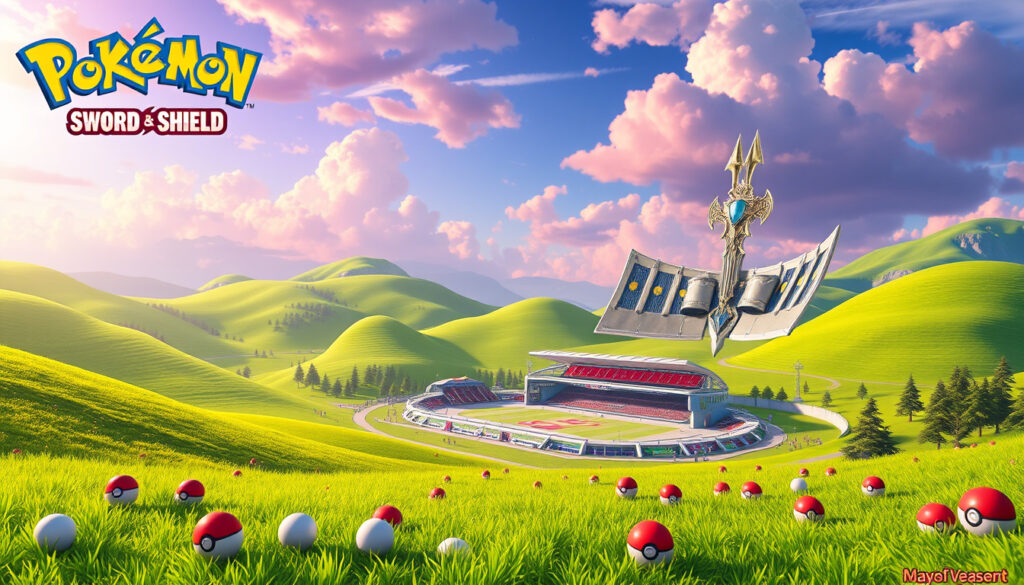
Pokémon Sword and Shield: Reviews, Differences, DLC Guide
Deciding between Pokémon Sword and Shield means choosing between Zacian or Zamazenta, fighting-type Bea or ghost-type Allister — but the real content gap lies in the Crown Tundra DLC that followed the game’s controversial 2019 launch. Here’s what you need to know before you pick a version.
Release Year: 2019 ·
Platform: Nintendo Switch ·
Region: Galar ·
Developer: Game Freak ·
Publisher: The Pokémon Company
Quick snapshot
- Long-term player preference patterns between Sword and Shield remain difficult to measure (GameFAQs)
- Crown Tundra DLC launched October 2020, expanding the base game significantly (WayTooManyGames)
- Expansion Pass remains available, making DLC a consideration for new buyers (RPG Site)
The key facts table below summarizes the essential metadata for Pokémon Sword and Shield and their DLC expansions.
| Field | Value |
|---|---|
| Release Date | November 15, 2019 |
| Developer | Game Freak |
| Region Inspiration | United Kingdom |
| Key Mechanic | Dynamax |
| Expansions | 2 DLC packs |
Why was Pokémon Sword and Shield controversial?
The backlash centered on Dexit — the decision to exclude roughly 500 Pokémon from the final game entirely. For the first time in the franchise’s mainline history, players could not transfer every creature from older games into the new title. This sparked petitions, debate threads, and long-running frustration among the community, with many longtime fans feeling the cut was indefensible for a console release (RPG Site).
Dexit backlash
The controversy crystallized when Game Freak confirmed that not all existing Pokémon would be reachable in Sword and Shield. Players who had invested years collecting and training creatures across multiple generations found those Pokémon simply unavailable — no bank transfer, no compatibility workaround. The decision reframed what “completing” a Pokédex meant for the series.
National Dex removal
Removing the National Dex was framed by developers as a practical trade-off — new models, animations, and systems required resources previously spent on porting every legacy creature. Critics argued that a home console launch should have enabled the opposite result, not justify further cuts.
Performance issues
Beyond the Pokédex dispute, Sword and Shield drew criticism for graphical fidelity and frame rate stability. The Wild Area, intended as an ambitious open zone, suffered from pop-in and performance dips that undercut the visual ambitions Game Freak had marketed. These technical shortcomings compounded the sense that the game had not delivered on its console potential (WayTooManyGames).
Is Pokémon Sword and Shield worth it?
For newcomers to the franchise or players returning after a break, Sword and Shield offer a streamlined point of entry — the Gym Challenge structure, quality-of-life additions like exp. share toggle, and the Dynamax mechanic create a satisfying loop even with the baggage of its launch controversies.
Review scores
Critics acknowledged the trade-offs. The game excelled at delivering focused tradition — the structured storyline and Galar region design earned praise — while the controversies around content cuts lingered as legitimate concerns (Tom’s Guide). No major outlet declared the game broken, but few called it a generational leap.
Gameplay improvements
Sword and Shield replaced traditional random encounters with Pokémon visibly inhabiting the overworld, creating a more deliberate exploration feel. The Dynamax mechanic, while divisive, added a distinctive battle option that rewarded positioning and team planning. Camp and Curry features introduced social gameplay that broadened multiplayer appeal.
DLC value
The Expansion Pass splits into two chapters: Isle of Armor (June 2020) and Crown Tundra (June 2020). The DLC content drew substantially more positive reception than the base game — reviewers consistently described Crown Tundra as “much better than the base game,” with a meaty campaign, puzzle-solving, and an addictive roguelike mode that justified the asking price (WayTooManyGames). Isle of Armor, while shorter, added Kubfu and the paid Fighting-type evolutionary line.
Base game owners who skipped DLC missed the best content the generation produced. RPG Site noted that “the DLC has, in almost every way, fixed major issues with the experience as a whole” (RPG Site).
Which is better, Pokémon Sword or Shield?
Sword and Shield share the same game world, story, and mechanics — the differences come down to version-exclusive Pokémon, Gym Leaders, and the box legendary. Neither version is objectively superior; the choice depends on which exclusives matter to you.
Version exclusives
The core exclusives are fixed by version. Sword features Bea (Fighting-type) and Gordie (Rock-type) as exclusive Gym Leaders, while Shield features Allister (Ghost-type) and Melony (Ice-type) (Tom’s Guide). Six common Gym Leaders — including Milo and Nessa — appear in both versions.
Legendary differences
The box legendaries differ significantly. Sword features Zacian, a sword-wielding Pokémon that attacks with a blade-like form, while Shield features Zamazenta, a defense-oriented Pokémon with a shield-like body that reflects incoming damage (TechRadar). Both appear in the respective game’s cover art and storyline.
In Crown Tundra DLC, Sword exclusives include Omanyte, Omastar, Bagon, Shelgon, and Salamence. Shield exclusives include Kabuto, Kabutops, Gible, Gabite, and Garchomp (TechRadar). This means catching a complete collection requires trading with the opposite version owner.
Player preferences
Community sentiment tilts toward preference rather than objective superiority. Some players favor Sword’s Fighting and Rock-type Gym Leaders for team-building variety. Others prefer Shield’s Ghost and Ice options for their typing advantages. Version choice ultimately reflects personal priorities rather than mechanical power — both games are fully playable and completable without cross-version trading if players accept missing exclusive creatures.
The comparison table below highlights the key version-exclusive features across both releases.
| Feature | Pokémon Sword | Pokémon Shield |
|---|---|---|
| Box Legendary | Zacian | Zamazenta |
| Exclusive Gym Leader 1 | Bea (Fighting) | Allister (Ghost) |
| Exclusive Gym Leader 2 | Gordie (Rock) | Melony (Ice) |
| Crown Tundra Exclusive Pokémon | Omanyte, Omastar, Bagon, Shelgon, Salamence | Kabuto, Kabutops, Gible, Gabite, Garchomp |
What are the key features of Pokémon Sword and Shield?
Sword and Shield introduced the Galar region — a Pokémon world modeled loosely on the United Kingdom — along with new mechanics, returning legendary storylines, and a roster of starter Pokémon that launched the generation.
Starters
The Galar starters are Grookey (grass), Scorbunny (fire), and Sobble (water). Each evolves into a distinct final form: Rillaboom, Cinderace, and Inteleon respectively. These three have appeared in competitive formats since their debut, with Inteleon particularly standing out in VGC and Smogon tiers for its speed and special attack stats.
Gym Leaders
The Galar Gym Challenge features eight Stadium Gyms, with a rotation of common and exclusive leaders depending on version. The champion Cup follows the Gyms, culminating in battles against the player before the postgame credits. Leon serves as the reigning champion throughout the storyline.
Legendaries
Beyond Zacian and Zamazenta, the main storyline introduces Eternatus as the Dynamax-causing entity. The Darkest Day event — tied to Eternatus — drives the narrative conflict that the player resolves by capturing this poison/dragon legendary. Crown Tundra adds Calyrex as a DLC legendary, with the ability to bond with Ice, Shadow, or Fire steed forms.
Dynamax remains the defining battle mechanic for this generation — it’s not available in Scarlet and Violet, so Sword and Shield remain the definitive platform for Dynamax-focused competitive play.
Should you play Pokémon Sword and Shield before newer games?
Whether to play Sword and Shield before Scarlet and Violet depends on your goals: if you want the most cohesive traditional Pokémon experience before the open-world shift, Sword and Shield serve as the last structured entry in the classic mold.
Play order with Scarlet/Violet
Scarlet and Violet (2022) introduced a fully open-world structure that diverges sharply from Sword and Shield’s linear Stadium layout. Playing Sword and Shield first gives you context for how the franchise evolved — Dynamax as a signature mechanic, the Galar region’s UK-inspired design, and the Dexit controversy’s legacy. Neither game requires the other for narrative completeness, but they represent different design philosophies.
DLC expansions
The Expansion Pass adds two substantial areas. Isle of Armor introduces the Winding Isles and Kubfu’s evolutionary quest. Crown Tundra brings the Pecharunt-filled max raid dens and the Dynamax Adventures roguelike mode (WayTooManyGames). Players who skipped DLC missed the generation’s peak content — Crown Tundra alone is described as “far better than the main game” by community reviewers (GameFAQs).
TCG and price
Pokémon Sword and Shield base game retailed at $59.99 at launch, with the Expansion Pass priced at $29.99. Physical and digital copies remain available through the Nintendo eShop. The Pokémon TCG also launched Sword and Shield-era card sets during this period, though card availability varies by market.
The specifications table below provides technical and gameplay details for both versions.
| Specification | Detail |
|---|---|
| Console | Nintendo Switch |
| Genre | Role-playing game (RPG) |
| Players | 1-4 (local multiplayer, online) |
| Play time (main story) | 25-35 hours |
| Play time (completionist) | 80-100+ hours |
| Rated | E (Everyone) |
| Language support | 9 languages |
| Save files | 6 per console |
Upsides
- Streamlined entry point for franchise newcomers
- Crown Tundra DLC delivers excellent content that fixes base game issues
- Dynamax mechanic adds strategic depth unique to this generation
- Galar region design is visually distinctive and well-paced
- Two DLC expansions provide substantial postgame replay value
- Best-in-series competitive tools and ranked online play
Downsides
- Dexit removes hundreds of Pokémon from competitive pool
- Graphics and frame rate lag behind Switch peers
- Isle of Armor DLC feels short and undercooked
- Wild Area performance issues diminish exploration appeal
- Version exclusivity requires trading for complete collection
- No National Dex means legacy collectors remain sidelined
What reviewers and players say
Pokémon Sword/Shield’s second DLC expansion, The Crown Tundra, is actually much better than the base game itself, believe it or not.
— WayTooManyGames Reviewer (WayTooManyGames)
The DLC has, in almost every way, fixed my major issues with the experience as a whole.
— RPG Site Reviewer (RPG Site)
The DLC is far better than the main game.
— GameFAQs Community Member (GameFAQs)
Pokémon Sword and Shield occupy a complicated legacy: a game that launched with legitimate controversy yet delivered its most satisfying content through DLC expansions that arrived months later. For buyers choosing between versions, the exclusives matter less than whether you plan to engage with Crown Tundra — that expansion alone makes the $59.99 purchase worthwhile for franchise fans who skipped it. For collectors prioritizing every creature, Sword and Shield remain a gateway with walls — and those walls only come down if you trade across versions or accept what’s locked away.
Related reading: Spider-Man Movies in Order · Xbox Game Pass Ultimate 12 Months
youtube.com, youtube.com, youtube.com, youtube.com, youtube.com
Pokémon Sword and Shield’s debut sparked the Dexit controversy that dominated early reviews and shaped opinions on the game’s value.
Frequently asked questions
What platform does Pokémon Sword and Shield run on?
Pokémon Sword and Shield are exclusive to the Nintendo Switch family — both the standard Switch and Switch Lite are compatible.
What is Dynamax in Pokémon Sword and Shield?
Dynamax is a battle mechanic introduced in Sword and Shield that allows any Pokémon to grow to massive size for three turns. Dynamaxed Pokémon have increased HP and can use Max Moves that correspond to their original type — for example, a Fire-type move becomes a Max Flame attack.
How do I get the Pokémon Sword and Shield DLC?
The Expansion Pass is available as a digital purchase through the Nintendo eShop. It covers both Isle of Armor and Crown Tundra. Once downloaded, the DLC areas appear on the Wild Area menu for players who have progressed past the first Gym.
What is the price of Pokémon Sword and Shield?
The base game launched at $59.99 and remains available at that price point digitally. The Expansion Pass costs $29.99. Physical copies occasionally appear at retail; prices vary by seller.
Are there Pokémon Sword and Shield TCG cards?
Yes. The Sword and Shield series in the Pokémon Trading Card Game launched concurrently with the video game, introducing the VMAX mechanic as the card-game equivalent of Dynamax. Cards remain legal in Standard format rotations.
What is the storyline of Pokémon Sword and Shield?
The player takes on the Gym Challenge in the Galar region, aiming to defeat all eight Stadium Gyms and eventually challenge Champion Leon. The subplot involves the Darkest Day — a phenomenon where Dynamax energy goes out of control, caused by the legendary Pokémon Eternatus.
Can I transfer Pokémon to Sword and Shield?
Transfer depends on whether the Pokémon exists in the Galar Pokédex. Only creatures programmed into the game are transferrable via Pokémon HOME. Many legacy Pokémon remain unavailable — this was the core of the Dexit controversy that surrounded the game’s launch.
More related posts
 BBC Weather Newton Mearns – Today, Tomorrow and 14-Day Forecast
 Maybelline Fit Me Concealer: Shade Guide, Tips & Review
 Charles de Gaulle Airport: Guide to CDG Paris Transport & Maps
 Simple Online Pharmacy Voucher Code: Valid Deals & Referrals
 Natalie Robb: Children, Emmerdale Exit, and Family Facts
 Breast Lump When to Worry: Hard Irregular Signs vs Benign
 Paul Smith Comedy: Wife, Net Worth, Tour 2026 & Biography
 EasyJet Hand Luggage Size: Rules, Limits & Tips 2025