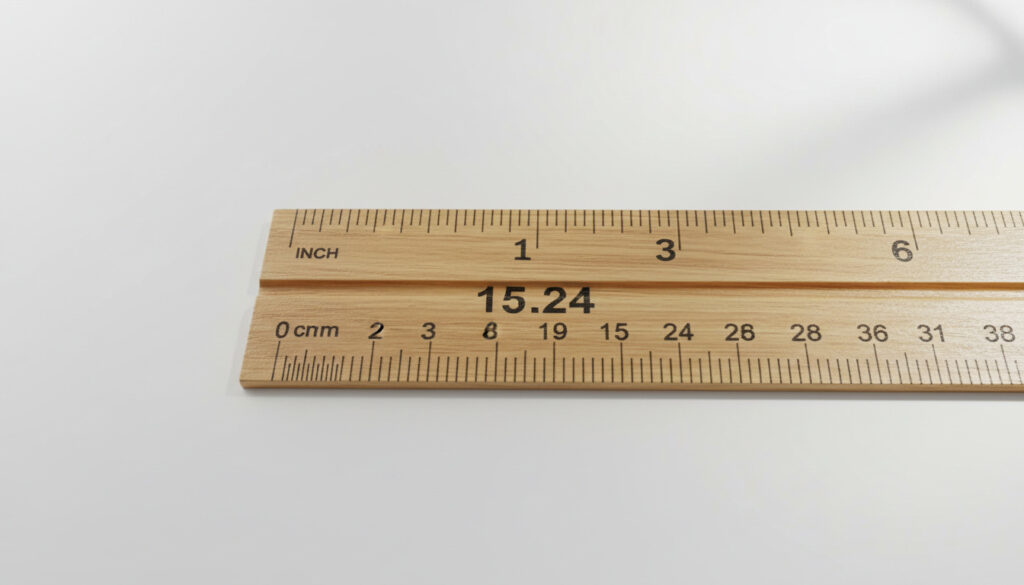
6 Inches in CM – Exact 15.24 cm Standard Guide
Six inches equals exactly 15.24 centimeters. This conversion relies on the international standard established in 1959, where one inch is defined as precisely 2.54 centimeters by the International Yard and Pound Agreement.
Unlike approximate conversions between other measurement systems, the relationship between inches and centimeters is exact by definition. The National Institute of Standards and Technology (NIST) and the International Bureau of Weights and Measures (BIPM) maintain this standard to ensure consistency across international trade, engineering specifications, and scientific research.
Understanding this precise conversion proves essential across numerous fields, from interpreting electronic screen diagonals and clothing measurements to working with technical drawings and construction materials standardized in mixed unit environments.
How Many CM Is 6 Inches?
The conversion yields an exact decimal value requiring no approximation for mathematical purposes. Six inches multiplied by 2.54 centimeters per inch results in 15.24 centimeters, a figure recognized universally by measurement standards organizations.
- The 2.54 cm standard has remained universal since the 1959 international treaty
- Six inches represents exactly 152.4 millimeters when converting to the smaller metric unit
- United States and United Kingdom construction industries commonly reference six-inch measurements for materials like pipes and lumber
- Fifteen point two four centimeters approximates the width of an average adult male hand span
- Global scientific communities exclusively use metric measurements to avoid conversion errors
- The conversion formula requires simple multiplication without division factors or complex calculations
| Inches | CM (exact) | CM (rounded) |
|---|---|---|
| 1 | 2.54 | 2.5 |
| 2 | 5.08 | 5.1 |
| 3 | 7.62 | 7.6 |
| 4 | 10.16 | 10.2 |
| 5 | 12.70 | 12.7 |
| 6 | 15.24 | 15.2 |
| 7 | 17.78 | 17.8 |
| 8 | 20.32 | 20.3 |
| 9 | 22.86 | 22.9 |
| 10 | 25.40 | 25.4 |
| 11 | 27.94 | 27.9 |
| 12 | 30.48 | 30.5 |
Source: RoboConverter Unit Standards
How to Convert Inches to CM
Converting measurements from inches to centimeters follows a straightforward multiplication process based on the defined conversion factor. The formula applies universally regardless of the specific measurement context, from small electronic components to large construction materials.
The Standard Formula
The precise formula requires multiplying the inch measurement by 2.54. For six inches, the calculation progresses as 6 × 2.54, yielding 15.24 centimeters immediately without intermediate rounding steps. BYJU’S mathematical references confirm this exact relationship.
Single Inch Reference
Understanding that one inch equals exactly 2.54 centimeters allows for rapid mental calculations. This base unit conversion enables estimations without calculators; six inches represents slightly more than fifteen centimeters, specifically 15.24 cm.
Engineering and scientific applications require the full 15.24 cm value without rounding. Construction and retail applications frequently round to 15 cm for simplicity, though this introduces a 0.24 cm discrepancy that may compound across multiple measurements.
Common Conversions Near 6 Inches
Measurements adjacent to six inches appear frequently in manufacturing specifications, display technology, and textile industries. Understanding these related conversions provides context for the six-inch measurement within broader size ranges.
5 Inches to CM
Five inches converts to exactly 12.70 centimeters using the standard formula. This measurement commonly appears in smartphone screen specifications and small electronic device dimensions.
7 Inches to CM
Seven inches equals exactly 17.78 centimeters. Tablet computers and automotive display screens frequently utilize this diagonal measurement.
6 Inches to Millimeters
Since one inch equals exactly 25.4 millimeters, six inches converts to precisely 152.4 millimeters. This conversion eliminates decimal places useful for precision machining and engineering specifications.
Reverse Conversion: 15 CM to Inches
Fifteen centimeters converts to approximately 5.91 inches using the inverse formula (centimeters × 0.39370079). Fifteen point two four centimeters equals exactly six inches.
A standard six-inch ruler aligns closely with the long edge of many modern smartphones, which typically measure between 14 and 16 centimeters diagonally. Visual comparison tools demonstrate this alignment on standard measurement instruments.
When to Use Inches vs CM
Measurement system selection depends primarily on geographic location, industry standards, and specific application requirements. While the conversion between systems is mathematically exact, practical usage patterns vary significantly across domains.
Regional and Industry Standards
The United States maintains inches as the primary unit for construction, manufacturing, and consumer products. The United Kingdom uses inches for road distances and personal measurements, though metric units dominate medical and scientific contexts. NIST conversion guidelines facilitate transitions between these systems.
Six Inches in Clothing Sizes
Clothing alterations and pattern making frequently reference six-inch adjustments. Waistband modifications, inseam adjustments, and sleeve lengths may specify six-inch changes, converting to 15.24 centimeters for European metric sizing systems. Retail environments often round this to 15 cm on international size charts.
Clothing sizes labeled in centimeters may differ by several millimeters from inch-based equivalents due to rounding conventions. A “15 cm” waist adjustment might represent either exactly 15 cm or the rounded equivalent of six inches (15.24 cm), depending on manufacturer standards.
Similar precision matters in biometric monitoring, where Normal Hemoglobin Levels by Age – Charts for Men, Women, Children demonstrate how specific measurement standards vary by demographic categories.
Evolution of the International Inch
-
The International Yard and Pound Agreement establishes the inch as exactly 25.4 millimeters (2.54 centimeters), unifying previously varying British and American definitions. BIPM standards documentation records this definition.
-
Commonwealth nations adopt the standardized inch definition, eliminating discrepancies in international trade specifications and engineering drawings.
-
United States legislation codifies the international inch definition for commercial and trade purposes, replacing previous customary unit variations.
-
Metric transition remains incomplete in American construction and manufacturing sectors, necessitating continued dual-system proficiency despite metric dominance in global markets.
Is the Conversion Exact?
| Definitively Established | Practical Application Notes |
|---|---|
| 6 inches = 15.24 cm exactly (no approximation) | Everyday usage often rounds to 15 cm for simplicity |
| Formula: inches × 2.54 (defined by international treaty) | Measurement tool precision affects real-world accuracy |
| Standardized since 1959 across all signatory nations | Regional adoption rates vary by industry sector |
| Recognized by NIST and BIPM as exact conversion | Legacy equipment may use pre-1959 definitions |
No mathematical uncertainty exists in the conversion itself. The value 15.24 represents an exact mathematical relationship, not an approximation or derived estimate.
Where You Encounter 6 Inches
Six-inch measurements appear across diverse contexts requiring precise spatial understanding. Display technology manufacturers specify six-inch diagonals for phablets and small tablets. Construction materials, including certain pipe diameters and lumber widths, utilize this measurement. Culinary applications reference six-inch cake pans and sandwich lengths.
Medical and fitness contexts also employ precise measurements. Understanding length conversions complements knowledge of physiological metrics like Good Resting Heart Rate – Chart by Age and Gender, where precise numerical standards inform health assessments.
The Standards Behind the Number
International metrological organizations maintain the definitions underlying this conversion. These standards ensure that six inches in London equals exactly six inches in Los Angeles, with both converting to precisely 15.24 centimeters.
The international inch is exactly 25.4 mm.
— National Institute of Standards and Technology (NIST)
1 in = 2.54 cm by definition.
— International Bureau of Weights and Measures (BIPM)
Source documents: NIST Handbook 44 Appendix C
Quick Reference Summary
Six inches converts to exactly 15.24 centimeters using the multiplication factor of 2.54. This standard, established in 1959 and maintained by international metrological organizations, applies universally across construction, manufacturing, technology, and commerce. For health and biological contexts where precise measurements matter, consult Good Resting Heart Rate – Chart by Age and Gender to understand how specific numeric standards apply to human physiology.
Frequently Asked Questions
How many cm in 1 inch?
Exactly 2.54 centimeters.
Is 6 inches 15 cm?
Approximately. Six inches equals exactly 15.24 cm, though many applications round to 15 cm for simplicity.
6 inches to mm?
Exactly 152.4 millimeters.
Why is 1 inch 2.54 cm?
The 1959 International Yard and Pound Agreement standardized this exact conversion to unify measurement systems internationally.
6 inches in cm for screen size?
A six-inch screen diagonal measures exactly 15.24 centimeters, though bezel dimensions may affect overall device size.
More related posts
 Michael K. Williams: Cause of Death, Net Worth, The Wire & Family
 B&Q Northampton: Opening Times, Address & Phone
 2024 Denver Nuggets vs Timberwolves Match Player Stats
 2 Seater Recliner Sofa – Compact UK Deals and Specs
 Play Chess Online Free: Top Sites for Beginners & Friends
 Whats On in Manchester – March 2025 Gigs and Events
 East Midlands Airport Lounge: Access, Cost & Is It Worth It?
 Deportivo Alavés vs Real Madrid Standings: Latest Table & History